
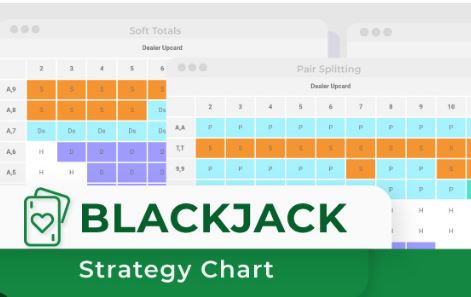
The following is a list of our very own classic blackjack strategies you should know about, especially if you are planning on playing real money online blackjack and you want to have the best odds of winning.
Blackjack is one of the most popular card games across online and physical casinos, and unlike slots, it's a game where your decisions actually move the house edge. Played with a correct basic strategy, blackjack offers one of the lowest house edges of any casino game - often under 1%. Play it carelessly, and that edge can balloon past 2%. The difference between the two comes down to knowing a handful of classic strategies and applying them consistently, every hand, regardless of how you "feel" about the cards.
To give you a nudge in the right direction, here are the strategies you'll want to remember the next time you play blackjack in Canada - or anywhere else real money is on the table.
Start With Basic Strategy
Before getting into individual tips, it's worth understanding where they come from: basic strategy. This is a mathematically derived set of decisions - hit, stand, double, split, or surrender - for every possible combination of your hand and the dealer's up card. It was worked out decades ago through computer simulations of millions of hands and hasn't really changed since, which is why it's still called "classic."
You don't need to memorize a chart to benefit from it. Most of what follows are the highest-impact basic strategy rules - the ones that make the biggest difference to your win rate if you actually use them.
Hard Totals: When to Hit or Stand
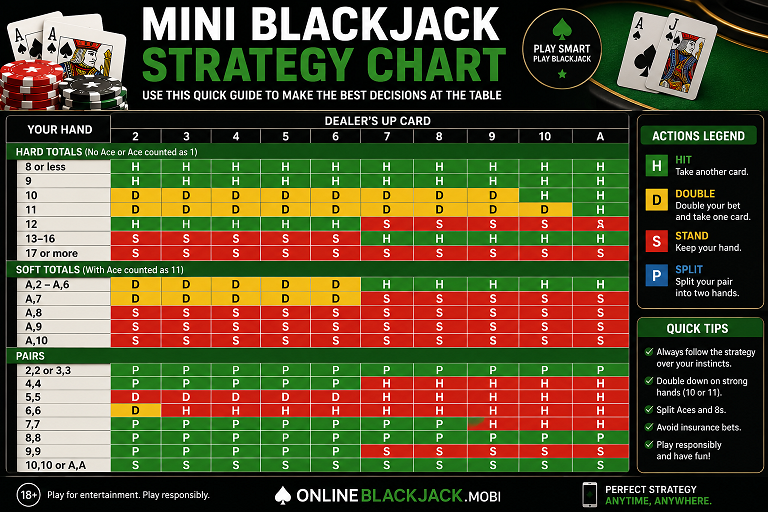
A "hard" hand is one without an ace, or one where the ace can only count as 1 (because counting it as 11 would bust you).
There's no risk of busting, so there's no reason not to take a card.
This is the danger zone, and where most players make mistakes. Whether you hit depends heavily on the dealer's up card. If the dealer shows a 2 through 6, stand - the dealer has a high chance of busting, so let them do the work. If the dealer shows a 7 or higher, hit, because the dealer is more likely to make a strong hand and you need to improve yours.
The odds of busting are too high to justify hitting.
Doubling Down: Real Cash Blackjack Tips
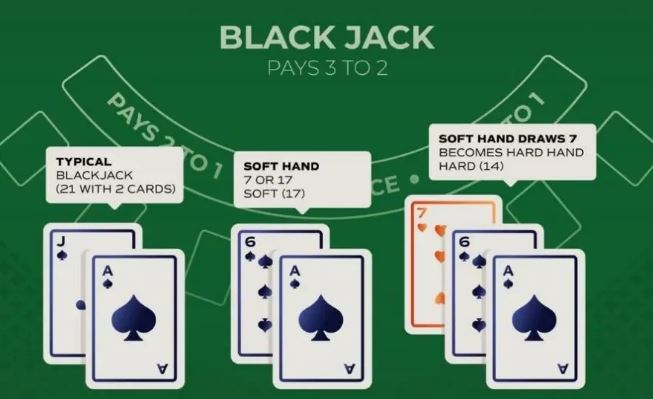
Doubling down means doubling your bet in exchange for exactly one more card - a powerful move when the odds favor you.
- If your two-card total is 9, 10, or 11, consider doubling down, as this gives you a good chance of ending on or close to 21 with a strong final total. The classic rule of thumb: double on 11 almost always, double on 10 unless the dealer shows a 10 or ace, and double on 9 only when the dealer shows 3 through 6.
- Many new players are too cautious with doubling down, treating it as a "risky" move. In reality, refusing to double in the right spots costs you money over the long run - it's one of the few times the math is squarely in your favor.
Splitting Pairs
If you're dealt a pair of aces, split them. This is one of the most valuable moves in the game, giving you two separate hands, each with a strong chance of hitting 21. Most casinos will only let you draw one additional card to each split ace, so play accordingly.
Always split 8s too. A hand of 16 is one of the weakest totals in blackjack, but two hands starting with 8 each have real potential.
On the flip side, never split 10s. A total of 20 is already excellent - breaking it into two hands to chase something better is a losing proposition.
Never split 5s either; treat a pair of 5s as a hard 10 and double down instead if the dealer's card allows it.
Soft Hands (When You Hold an Ace)
A "soft" hand includes an ace counted as 11, giving you flexibility since it can't bust on the next card. Soft 13 through 17 (A-2 through A-6) generally call for hitting or doubling against weaker dealer cards, since you can't bust by taking a card. Soft 18 (A-7) is a borderline hand - stand against a dealer 2, 7, or 8, but consider hitting or doubling against 9, 10, or ace, since the dealer is likely to end up strong. Soft 19 or higher should almost always stand.
Know the Dealer's Rules Before You Sit Down
Another real cash blackjack tip that you'll find helpful is that in many games, dealers must hit on "soft 17" and stand on "hard 17." A soft 17 means one of the dealer's cards is an ace valued at 1 rather than 11 - for example, an ace and a 6. Knowing whether the table you're playing at hits or stands on soft 17 matters because it changes the house edge slightly (tables where the dealer hits soft 17 favor the house a bit more), and it should influence how you play close hands like 12 through 16.
Table rules are worth checking before you ever place a bet. Look out for:
Number of decks: Single- and double-deck games generally favor the player more than six- or eight-deck shoes.
Blackjack payout: A 3:2 payout on a natural blackjack is standard and player-friendly. Some tables now offer 6:5, which quietly increases the house edge - avoid these where possible.
Doubling restrictions: Some tables only allow doubling on totals of 9, 10, or 11 ("double on 10/11 only"), which limits your options compared to tables that let you double on any two cards.
Surrender option: Where available, "late surrender" lets you forfeit half your bet on a clearly weak hand (like a hard 16 against a dealer's 9, 10, or ace) instead of playing it out - a small but useful tool for cutting your losses.
Related: hard-hand strategy · blackjack surrender · winning strategy concepts
Insurance: Understand It Before You Buy It
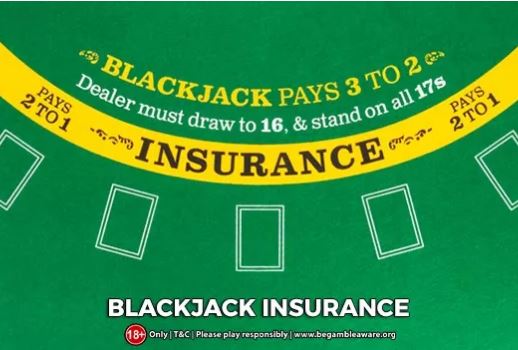
If the dealer is showing an ace, you'll be offered the chance to purchase insurance, an optional side bet worth up to half your original wager. If the dealer does have blackjack, insurance pays 2:1, which offsets the loss on your main bet.
It sounds like a safety net, but the math tells a different story: insurance is only profitable if you know the ratio of ten-value cards left in the deck is high enough to justify it, which the average player has no way of tracking. Over the long run, buying insurance on a random hand is a losing bet for the average recreational player, even though it feels protective in the moment. The same logic applies to "even money," which is really just insurance in disguise offered when you personally have a blackjack.
Read the full insurance guide →Bankroll and Bet Sizing
Strategy on individual hands is only half the picture - how you manage your money across a session matters just as much:
- $Set a session budget before you sit down
Set a session budget before you sit down, and stick to it regardless of how the cards are running.
- ↔Keep your bet size consistent
Keep your bet size consistent relative to your bankroll. Wildly increasing bets to "chase" losses is one of the fastest ways to turn a manageable session into a costly one.
- ↓Use low table minimums while learning
Take advantage of low table minimums when you're still building confidence with basic strategy, and save bigger bets for once the decisions become second nature.
A Few Common Mistakes to Avoid
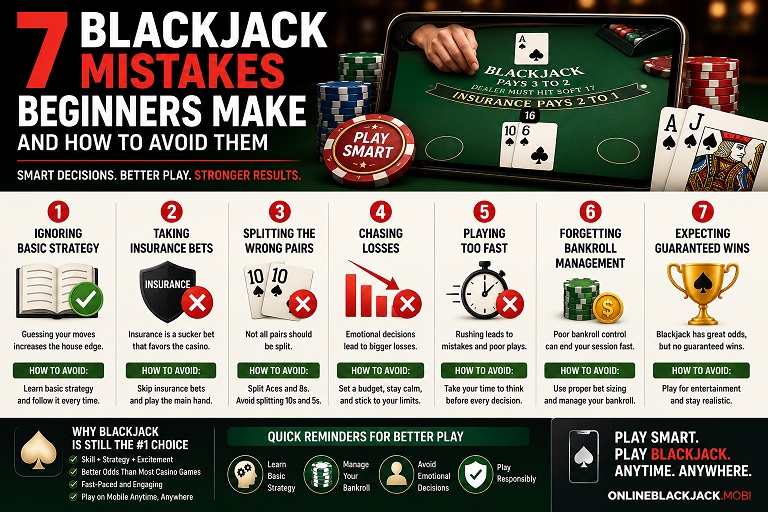
Taking insurance out of habit. As covered above, it's rarely worth it for the average player.
Standing on 16 against a dealer's 10 out of fear of busting. Basic strategy says hit - the math favors it even though it feels uncomfortable.
Not doubling down when the odds call for it, because it feels safer to just hit for one card at a time.
Splitting 10s because "20 plus 20 is better than one 20." It isn't, statistically.
Ignoring the dealer's up card and playing your hand the same way regardless of what they're showing. Nearly every classic strategy decision hinges on that one visible card.
For a longer breakdown of beginner errors, see our common blackjack mistakes guide.
Putting the Strategies Together
So, whether you're playing mini blackjack, 21 duel blackjack, or any form of this card game, incorporate these strategies into your gameplay for higher winnings. None of them guarantee a win on any single hand - blackjack is still a game of chance - but applied consistently, they give you the best mathematical shot at coming out ahead over time.
The strongest classic blackjack habit is consistency: use the cards, the dealer's up card and the table rules to make the decision, rather than changing strategy because of a streak or a hunch.