
6-Deck Blackjack: Rules, House Edge & Where to Play
Six-deck blackjack is, by a wide margin, the most common version of the game you'll encounter - both in land-based casinos and across online blackjack lobbies. It's the format most players learn on, the format most strategy charts default to, and the format that strikes the practical balance casinos rely on: enough deck depth to slow down card counters, while still keeping a house edge low enough to remain an attractive, popular game. This guide covers exactly how six-deck blackjack works, its odds, how it compares to double deck and eight-deck alternatives, and what to check before you sit down.
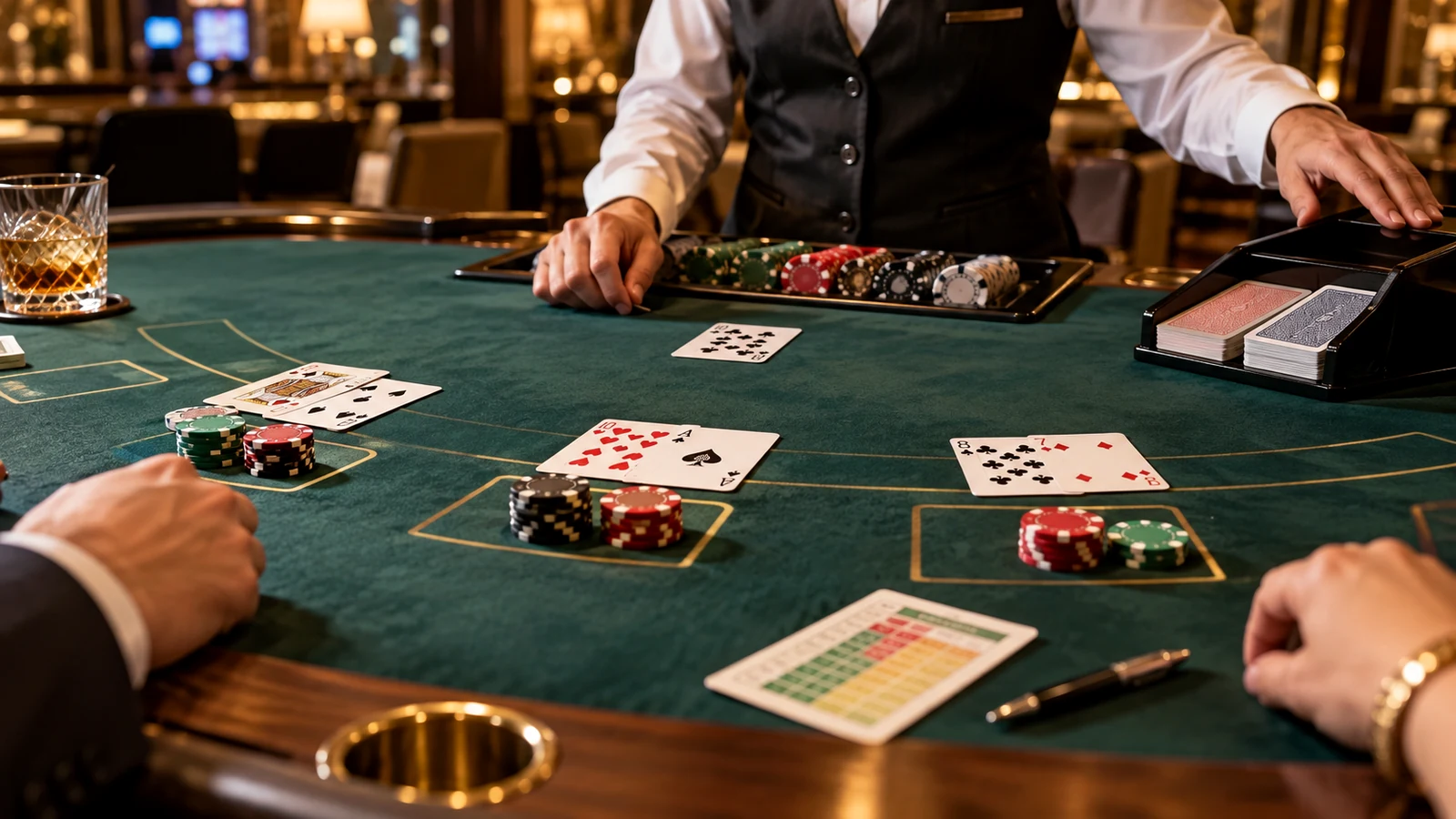
- Cards: Six standard 52-card decks
- Dealing: Usually dealt from a shoe
- Typical: About 0.5%-0.65% under standard rules
- Availability: One of the most widely offered formats
Six-deck blackjack is, by a wide margin, the most common version of the game you'll encounter - both in land-based casinos and across online blackjack lobbies. It's the format most players learn on, the format most strategy charts default to, and the format that strikes the practical balance casinos rely on: enough deck depth to slow down card counters, while still keeping a house edge low enough to remain an attractive, popular game. This guide covers exactly how six-deck blackjack works, its odds, how it compares to double deck and eight-deck alternatives, and what to check before you sit down.
What Is Six-Deck Blackjack?
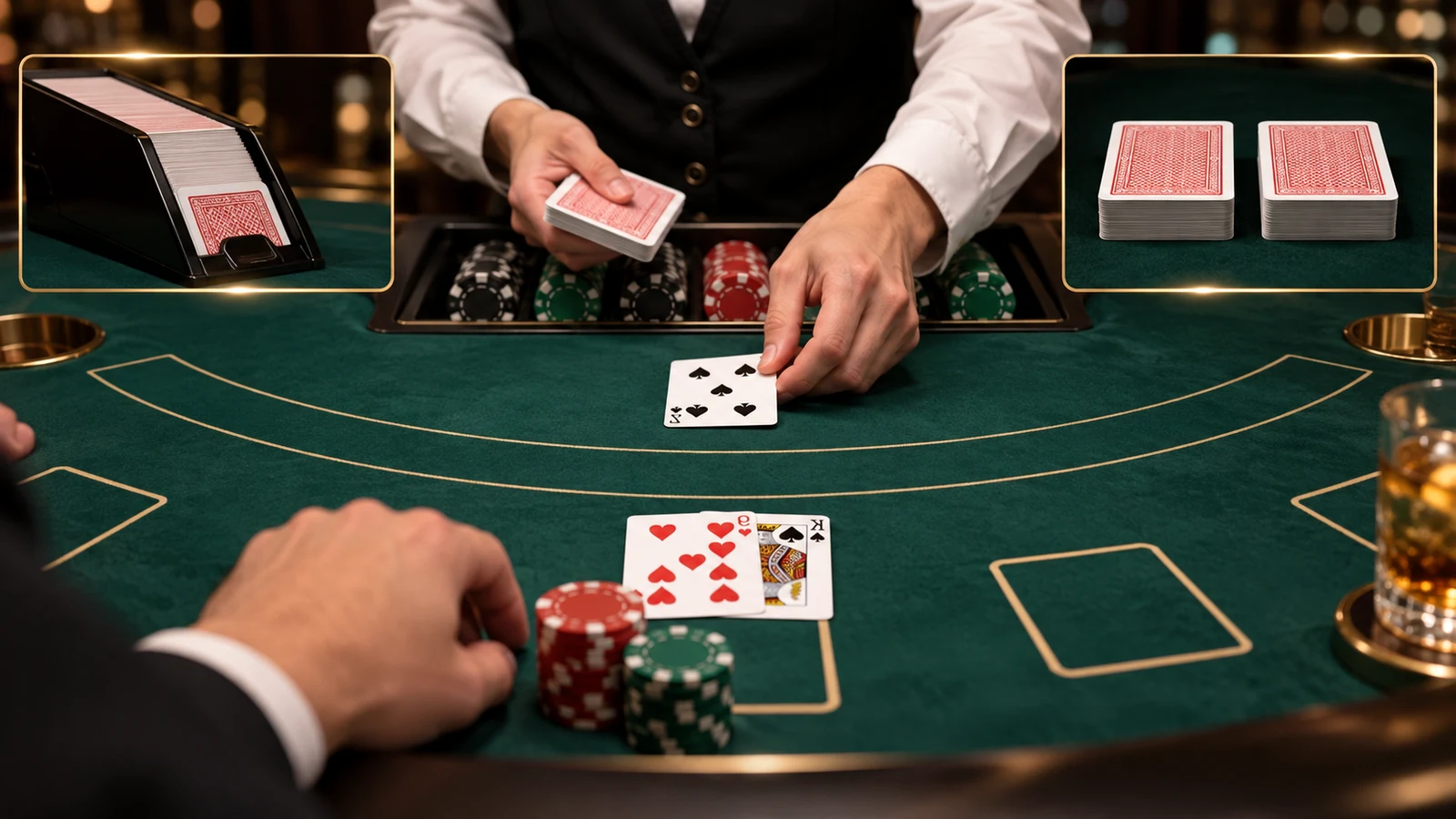
Six-deck blackjack is played from a shoe containing six standard 52-card decks shuffled together - 312 cards total. The core rules of blackjack are unchanged from any other version: you're dealt two cards, the dealer shows one card face up, and you choose to hit, stand, double down, split, or surrender (where offered) based on your hand versus the dealer's up card, aiming to beat the dealer's hand without exceeding 21.
What distinguishes six-deck games mechanically is the shoe itself: rather than being dealt by hand from a held deck (as with double deck games), six-deck blackjack is dealt from a mechanical or electronic shoe that holds the full six-deck stack, allowing for faster, more continuous dealing and less frequent reshuffling.
Why Six Decks Became the Standard
Casinos settled on six decks (and, in some cases, eight) as a practical middle ground for a specific reason: a larger shoe dramatically reduces the effectiveness of card counting, since removing any individual card has a much smaller proportional effect on the remaining shoe composition compared to a two-deck game. At the same time, six decks still allow for a house edge low enough - typically under 0.6% with favorable rules - to remain competitive with other games and keep players coming back.
This makes six-deck blackjack the format casinos can offer at low minimum bets across an entire floor without the elevated counting risk that comes with double deck or single deck games, which is why it dominates casino floors and online blackjack lobbies alike.
Six-Deck Blackjack House Edge
Under standard rules with a 3:2 blackjack payout and optimal basic strategy, six-deck blackjack typically carries a house edge in the range of 0.5% to 0.65% - slightly higher than double deck's typical 0.35-0.65% range, but still among the lowest house edges available in mainstream casino games.
| Rule Variation | Effect on House Edge |
|---|---|
| Blackjack pays 3:2 | Standard, baseline edge |
| Blackjack pays 6:5 | Adds approximately 1.4% to the house edge |
| Dealer stands on soft 17 | Better for the player (lower edge) |
| Dealer hits soft 17 | Adds approximately 0.2% to the house edge |
| Double after split allowed | Better for the player (lower edge) |
| Resplitting Aces allowed | Better for the player (lower edge) |
| Late surrender offered | Better for the player when used correctly |
As with any blackjack variant, the specific combination of table rules matters more than the deck count alone. A six-deck game with favorable rules (3:2 payout, dealer stands on soft 17, doubling and splitting freely allowed) can offer better value than a double deck game with a 6:5 payout or restrictive doubling rules. Our blackjack odds and house edge guide breaks down exactly how much each individual rule shifts the edge, which is useful for comparing specific tables directly.
Six-Deck vs. Double Deck: The Core Trade-Off
| Factor | 6-Deck | Double Deck |
|---|---|---|
| House edge (3:2, S17) | ~0.5-0.65% | ~0.35-0.65% |
| Card counting viability | Low - shoe barely shifts per card | High - count shifts quickly |
| Dealing method | Mechanical/electronic shoe | Usually hand-dealt |
| Pace of play | Generally faster | Generally slower |
| Availability | Very widely available | Less common, often higher minimums |
| Typical minimum bets | Lower, more accessible | Often higher |
For a full side-by-side breakdown of these two formats, including specific strategy differences, see our dedicated double deck blackjack guide. The short version: double deck offers a marginally better house edge and a more favorable counting environment, while six-deck offers wider availability, lower minimums, and a faster pace of play.
Six-Deck vs. Eight-Deck Blackjack
Eight-deck games are common on the highest-volume casino floors and follow the same underlying logic as six-deck games, simply with slightly more cards in the shoe. The practical difference in house edge between six and eight decks is small - typically a fraction of a percentage point - and far less significant than the difference created by rule variations like the blackjack payout ratio or the dealer's soft 17 rule. For most players, the choice between six-deck and eight-deck tables offering identical rules comes down to availability rather than any meaningful strategic advantage one way or the other.
Basic Strategy for Six-Deck Blackjack
The vast majority of published blackjack basic strategy charts - including the strategy chart used most widely across online guides and casino reference cards - are built specifically around six- or eight-deck shoe games, since this is the format most players will actually encounter. This means a standard strategy chart is generally safe to apply directly at a six-deck table without the deck-specific adjustments required for double deck or single deck games.
For a complete breakdown of every hit, stand, double, and split decision by hand and dealer up card, see our full blackjack strategy chart. If you specifically want to focus on pair-splitting decisions, our blackjack splitting strategy guide covers when to split and when to treat pairs as a single hand in detail.
Why Card Counting Is Harder in Six-Deck Games
Card counting systems like Hi-Lo work by tracking the ratio of high-value to low-value cards remaining in the shoe, using that ratio to estimate whether the remaining cards favor the player or the dealer. In a six-deck shoe, this ratio changes far more slowly than in a double deck game, since each individual card removed represents a much smaller fraction of the 312-card total. This means a counter typically needs to see significantly more cards dealt before the true count shifts meaningfully enough to justify increasing bets - a key reason why serious card counters generally prefer double deck or single deck games when available, and why casinos are comfortable offering six-deck games at low stakes across their entire floor. For more on how counting systems actually work, see our guide to the Hi-Lo card counting system.
Penetration and Reshuffling in Six-Deck Games
"Penetration" refers to how many cards are dealt from the shoe before the dealer reshuffles. In a six-deck game, casinos typically allow deeper penetration than they would in a double deck game - sometimes dealing through 75% or more of the shoe before reshuffling - precisely because the counting risk is already low enough that deeper penetration doesn't meaningfully increase player advantage the way it would in a smaller shoe. This deeper penetration is part of what makes six-deck games efficient to run at high volume, since reshuffling less frequently keeps the game moving faster.
Playing Six-Deck Blackjack Online
Six-deck blackjack is the default or near-default format at the vast majority of online casinos, offered both as an RNG (virtual) title and as a live dealer game. Because RNG versions use a certified random number generator rather than a physically depleting shoe, the deck-count distinction matters less for the mechanics of individual rounds online than it does in a live, physically dealt game - though the labeled deck count still affects the theoretical house edge calculation built into the game's published RTP.
Live dealer six-deck blackjack, streamed from a studio with a real dealer and shoe, more closely replicates the land-based experience, including visible shuffling and shoe penetration, for players who want that added layer of authenticity. For players comparing the live experience directly, our guide to live blackjack covers what to expect from streamed dealer games more broadly.
Six-Deck Blackjack and Real Money Play
Because six-deck games are the most widely available format at nearly every stake level, they're also the most common starting point for players moving from free-play or demo tables into real money blackjack. Our guide to real money online blackjack covers the practical steps involved - deposits, verification, and choosing a table - most of which apply directly to six-deck games as the default format at most operators.
Who Should Play Six-Deck Blackjack?
Six-deck blackjack suits:
- Players who want the widest possible table selection, since it's the most commonly offered format across both land-based and online casinos.
- Players who prioritize lower minimum bets, since six-deck tables are typically more accessible than double deck or single deck tables at the same casino.
- Players who aren't focused on card counting, since the larger shoe reduces counting effectiveness compared to smaller-deck formats.
- Beginners, since the vast majority of published strategy charts and practice tools are built specifically around six- or eight-deck rules, making it easier to find accurate, directly applicable strategy resources.
Players specifically pursuing card counting, or seeking the lowest theoretical house edge available, may find double deck or single deck tables - where offered with favorable rules - a better fit despite their relative scarcity and typically higher minimums.
Frequently Asked Questions
Is six-deck blackjack worse than double deck blackjack? The house edge is typically slightly higher on six-deck games (around 0.5-0.65%) compared to double deck (around 0.35-0.65%), assuming identical rules otherwise, but the difference is usually smaller than the impact of individual rule variations like the blackjack payout ratio.
Why do casinos prefer offering six-deck games? A larger shoe significantly reduces the effectiveness of card counting while still maintaining a low house edge, allowing casinos to offer the game widely and at low minimum bets without substantial counting risk.
Does basic strategy change for six-deck blackjack? No significant changes are needed - most published basic strategy charts are built specifically around six- or eight-deck rules, making them directly applicable without the deck-specific adjustments required for double deck or single deck games.
What's the difference between six-deck and eight-deck blackjack? The difference in house edge between the two is minimal - generally a fraction of a percentage point - and far less significant than the effect of specific table rules like the blackjack payout ratio or the dealer's soft 17 policy.
What should I check before playing a six-deck table? As with any blackjack variant, confirm the blackjack payout ratio (3:2 is standard; 6:5 significantly increases the house edge) and whether the dealer stands or hits on soft 17, since these rules have the largest individual impact on your overall odds.
This guide is for informational purposes. Always gamble responsibly and within your means.