
European Blackjack Strategy & Rules: The Complete Guide
European blackjack looks nearly identical to the American game you already know - same cards, same goal of beating the dealer without going over 21 - but a handful of structural rule differences change both the odds and the correct strategy in specific, important situations. If you've sat down at a table labeled "European Blackjack" and wondered why your usual strategy chart felt slightly off, this guide explains exactly what's different, why it matters, and how to adjust your play accordingly.

- No hole card: Dealer second card comes after players act
- Caution: Double/split decisions are more conservative
- Payout check: Table payout remains a major rule factor
- Typical: About 0.4%-0.8% depending on rules
European blackjack looks nearly identical to the American game you already know - same cards, same goal of beating the dealer without going over 21 - but a handful of structural rule differences change both the odds and the correct strategy in specific, important situations. If you've sat down at a table labeled "European Blackjack" and wondered why your usual strategy chart felt slightly off, this guide explains exactly what's different, why it matters, and how to adjust your play accordingly.
What Is European Blackjack?
European blackjack is a blackjack variant, most commonly found at European-facing casinos and widely offered across online blackjack lobbies, that differs from standard American blackjack in a few specific structural ways - most notably in how and when the dealer receives their second card, and in some restrictions around doubling down and splitting. It's typically dealt from two decks, though variations with different deck counts exist depending on the specific casino or software provider.
The rules below describe the most common European blackjack rule set, though - as with any blackjack variant - it's always worth checking the specific table's posted rules before playing, since exact details can vary between casinos and providers.
The Key Structural Difference: No Hole Card
The single most important difference between European and American blackjack is how the dealer's hand is dealt. In standard American blackjack, the dealer receives two cards immediately - one face up, one face down (the "hole card") - before players act. This means the dealer already knows whether they have blackjack before any player makes a decision, even though players don't see the hole card until later.
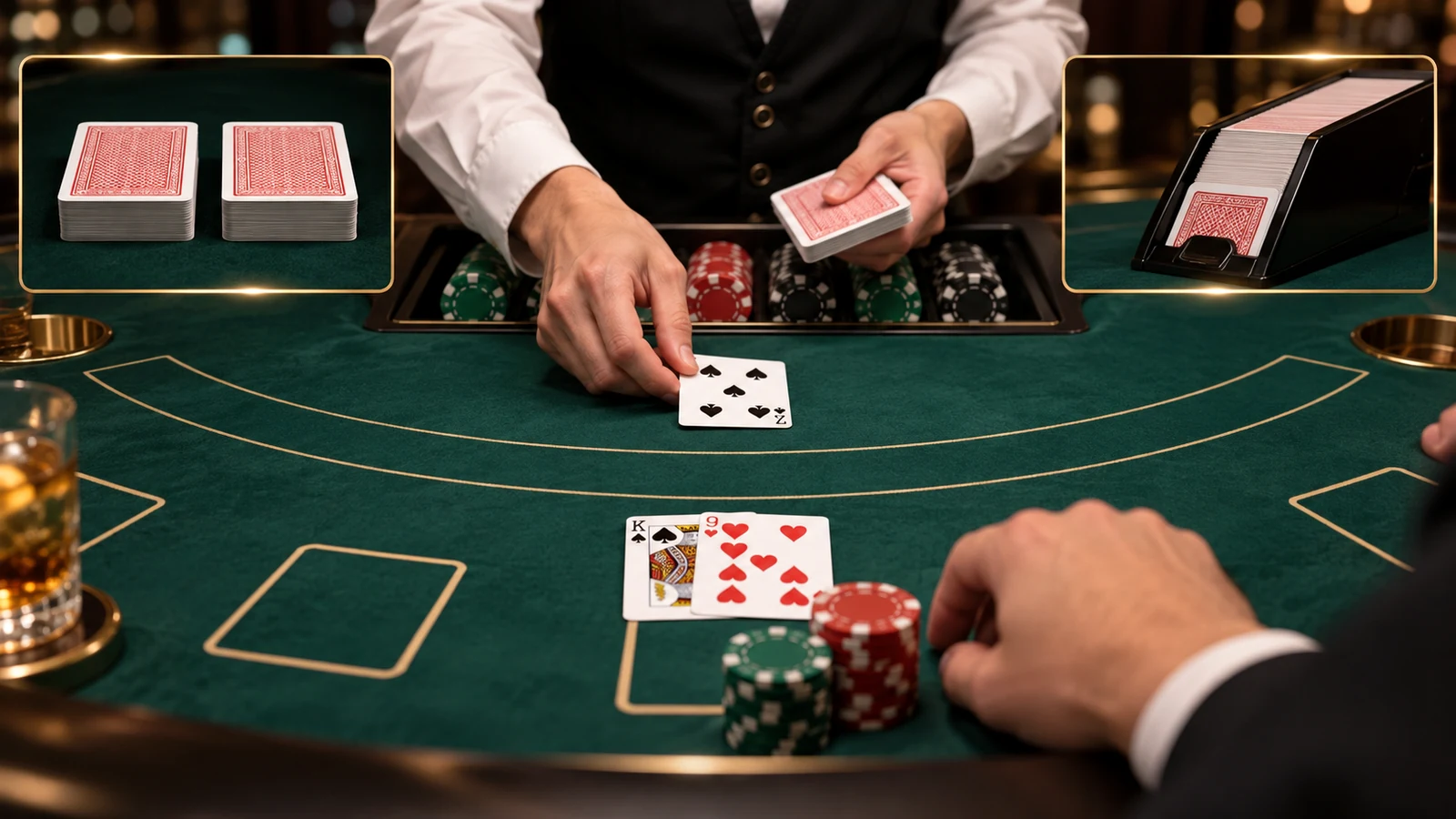
European blackjack does not use a hole card. Instead, the dealer is dealt only one card face up initially, and does not receive their second card until after all players have completed their hands. This structural change has a real strategic consequence, described below.
Why No Hole Card Changes Your Strategy
Because the dealer's second card isn't drawn until after every player has acted, there's a specific risk in European blackjack that doesn't exist in the American version: a player can double down or split, invest additional money into their hand, and then discover the dealer actually had blackjack all along - at which point the player loses not just their original bet, but their entire doubled or split investment as well.
In standard American blackjack, this risk doesn't exist in the same way, because the dealer's hole card is already determined (even if unseen) before you decide to double or split - if the dealer has blackjack, the hand typically ends immediately via "peek" rules before you're able to invest additional money into a losing situation.
This difference means that in European blackjack, correct basic strategy is more conservative in specific situations where the dealer shows an Ace or a 10-value card, since the potential downside of doubling or splitting into an undrawn dealer blackjack is real and must be accounted for mathematically. A player using an unmodified American strategy chart at a European table will, in these specific spots, be making a play with worse expected value than the European-adjusted version of the same decision.
Key Strategy Adjustments for European Blackjack
Doubling Down Against a Dealer Ace or 10
In American blackjack, certain double-down plays against a dealer's Ace or 10-value up card are standard, since the dealer's blackjack risk is already resolved via the hole card and peek rule before you act. In European blackjack, because that risk remains live, some of these same doubling plays shift toward simply hitting instead, particularly on hands like a hard 9, 10, or 11 against a dealer's Ace or 10, where the no-hole-card risk slightly reduces the expected value of doubling compared to the American equivalent.
Splitting Against a Dealer Ace or 10
Similarly, several pair-splitting decisions against a dealer's Ace or 10 become more conservative in European blackjack for the same underlying reason - splitting doubles your total action against a hand that might still turn out to be an undrawn dealer blackjack, which the American hole-card rule would have already revealed before you committed additional money.
Standard Strategy Otherwise Applies
Outside of these specific no-hole-card adjustments, the core logic of basic strategy - when to hit, stand, and how to play soft hands - remains largely consistent with standard strategy. The differences are concentrated specifically around doubling and splitting decisions against strong dealer up cards (Ace and 10-value cards), rather than a wholesale change to the entire strategy chart. For the full baseline chart these adjustments are built on top of, see our complete blackjack strategy chart, and for splitting decisions specifically, our dedicated blackjack splitting strategy guide.
European Blackjack House Edge
Under commonly offered European blackjack rules, the house edge typically falls in the range of 0.4% to 0.8%, depending heavily on the specific table's rule combination - a range broadly comparable to standard American blackjack, though the exact figure shifts based on several factors:
| Rule Variation | Effect on House Edge |
|---|---|
| No hole card (European standard) | Adds a small increment versus hole-card games, offset by correct strategy adjustment |
| Blackjack pays 3:2 | Standard, baseline edge |
| Blackjack pays 6:5 | Adds approximately 1.4% to the house edge |
| Dealer stands on soft 17 | Better for the player (lower edge) |
| Doubling restricted to 9, 10, 11 only | Slightly worse for the player than unrestricted doubling |
| Resplitting restrictions | Slightly worse for the player when limited |
As with every blackjack variant, the specific rule combination matters more than the "European" label alone. Our blackjack odds and house edge guide breaks down how each individual rule shifts the edge, which is useful for comparing a specific European table against an American equivalent directly.
Other Common European Blackjack Rule Differences
Beyond the no-hole-card structure, European blackjack tables sometimes apply additional restrictions not always present in American games:
- Doubling down restricted to hard totals of 9, 10, or 11, rather than being allowed on any two-card total, which is common in many American games.
- Limited resplitting, sometimes capping the number of times a hand can be split, or restricting resplitting of Aces specifically.
- Split Aces typically receive only one additional card each, with no further splitting or doubling allowed on the resulting hands.
These specific restrictions vary by casino and provider, so it's worth checking a table's posted rules directly rather than assuming a fixed universal rule set applies to every game labeled "European Blackjack."
European Blackjack vs. American Blackjack: Quick Comparison
| Factor | European Blackjack | American Blackjack |
|---|---|---|
| Dealer's second card | Drawn after all players act (no hole card) | Drawn immediately (hole card, hidden until later) |
| Doubling restrictions | Often limited to hard 9, 10, 11 | Often unrestricted |
| Risk of doubling/splitting into dealer blackjack | Real - factored into strategy | Effectively eliminated by the hole-card peek rule |
| Typical house edge | ~0.4-0.8% | ~0.5-0.7% |
| Typical deck count | Often 2 or 6 decks, varies by provider | Varies widely, commonly 6 or 8 decks |
For a more detailed side-by-side breakdown of these two formats, including how the underlying rule philosophy differs, see our dedicated guide comparing American vs. European blackjack directly. If you're specifically interested in how the American version handles its own variant-specific rules, our American blackjack guide covers that format in full.
Why the No-Hole-Card Rule Exists
The no-hole-card structure isn't arbitrary - it reflects a different historical approach to dealing procedure that developed in European casinos, where dealing only one card to the dealer initially, and completing the dealer's hand only after all players finish, became the regional standard. While this creates the specific doubling and splitting risk described above, it's balanced elsewhere in the rule set (and in the correct strategy adjustments), which is why European blackjack's overall house edge remains competitive with American blackjack despite this structural difference, provided players adjust their strategy correctly for the no-hole-card risk.
Playing European Blackjack Online
European blackjack is widely available at online casinos, both as an RNG (virtual) title and as a live dealer format. Because the no-hole-card rule is a defined game rule rather than a physical dealing quirk, it applies identically whether you're playing an RNG version or a live-streamed table - the dealer's second card simply isn't drawn until after all players complete their hands, regardless of format.
When choosing a European blackjack table online, it's worth checking the specific game's rules panel to confirm the doubling restrictions, deck count, and blackjack payout ratio, since these details can vary meaningfully between providers even though all are labeled under the same "European Blackjack" name.
Should You Play European or American Blackjack?
Neither format offers a decisively better house edge in general - the outcome depends far more on the specific table's rule combination (blackjack payout, soft 17 rule, doubling restrictions) than on the American-vs-European distinction itself. The more important practical takeaway is this: if you're playing European blackjack, use a strategy chart built for the no-hole-card rule, rather than applying an unmodified American strategy chart. The difference between the two charts is concentrated in a relatively small number of doubling and splitting decisions, but getting those specific decisions right matters in a game where the overall house edge is already this thin.
Frequently Asked Questions
What is the main difference between European and American blackjack? European blackjack doesn't use a hole card - the dealer's second card isn't drawn until after all players have completed their hands, unlike American blackjack, where the dealer's second card is dealt (though hidden) from the start.
Does the no-hole-card rule increase the house edge? It has a small effect on its own, since it creates a specific risk when doubling or splitting against a dealer Ace or 10 - but this is largely offset when players apply correctly adjusted strategy for those specific situations.
Can I use a standard blackjack strategy chart at a European table? Mostly, yes - but a handful of doubling and splitting decisions against a dealer Ace or 10 should be adjusted to account for the no-hole-card risk, so using a chart built specifically for European rules is recommended for optimal play.
Is European blackjack better or worse than American blackjack? Neither is inherently better - the house edge depends much more on the specific table's rule combination (payout ratio, soft 17 rule, doubling restrictions) than on the European-vs-American distinction alone.
How many decks does European blackjack typically use? It varies by casino and provider, though two-deck and six-deck versions are both common. Always check the specific table's rules to confirm the deck count and other rule details.
This guide is for informational purposes. Always gamble responsibly and within your means.