
Spanish 21 Basic Strategy Chart & Cheat Sheet
Spanish 21 rewards players with some of the most generous bonus payouts and player-friendly rules in the blackjack family - but it also plays by a noticeably different strategy than standard blackjack, precisely because the deck itself is different. If you've been using a regular blackjack strategy chart at a Spanish 21 table, you've likely been making several technically incorrect decisions without realizing it. This guide breaks down exactly how Spanish 21 strategy differs, and provides a complete decision framework for hitting, standing, doubling, and splitting.
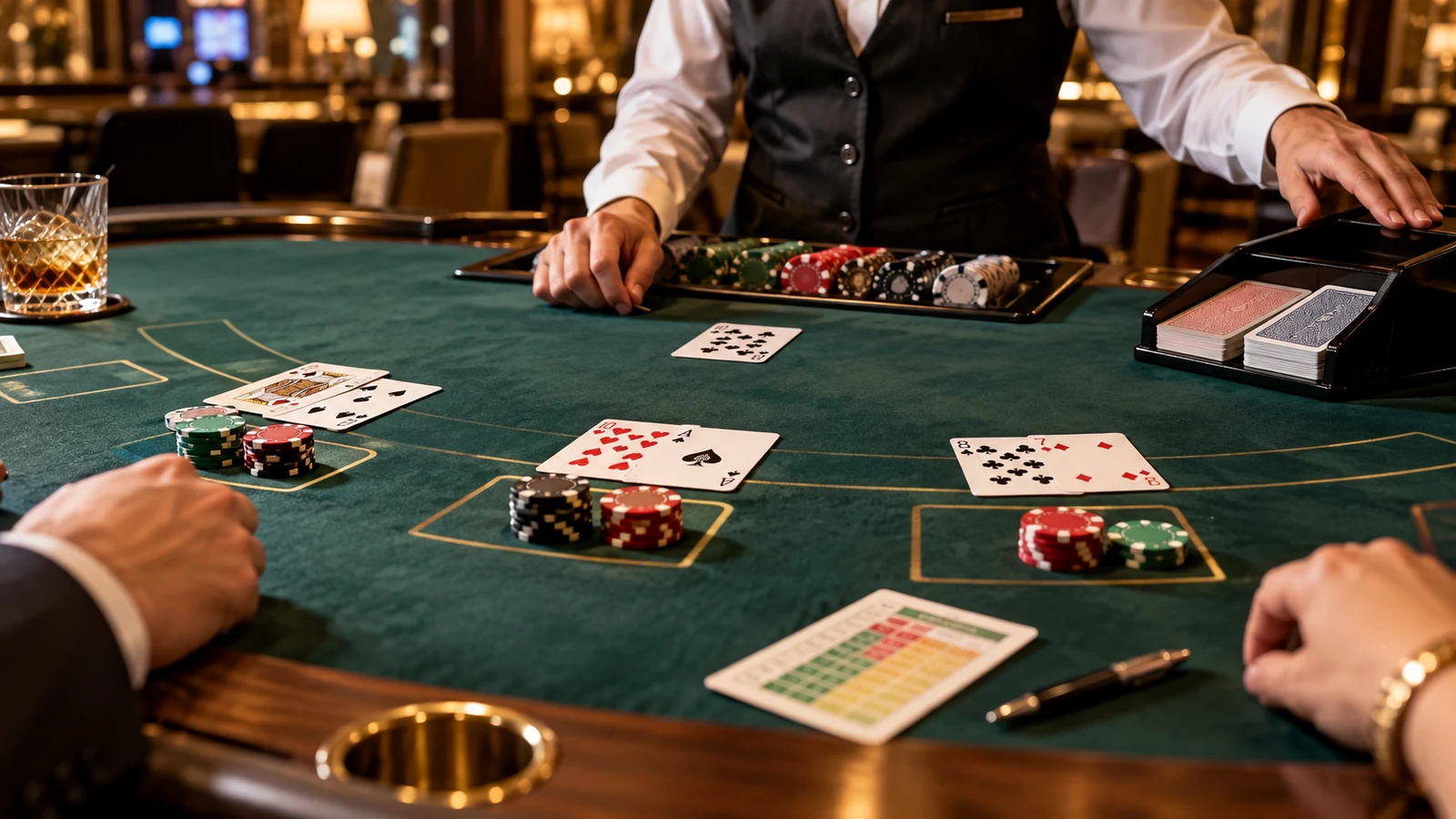
- Spanish deck: 10 cards are removed
- More doubles: Doubling is used more aggressively
- Surrender: Late surrender is used more often
- Player edge rule: Player 21 beats dealer 21
Spanish 21 rewards players with some of the most generous bonus payouts and player-friendly rules in the blackjack family - but it also plays by a noticeably different strategy than standard blackjack, precisely because the deck itself is different. If you've been using a regular blackjack strategy chart at a Spanish 21 table, you've likely been making several technically incorrect decisions without realizing it. This guide breaks down exactly how Spanish 21 strategy differs, and provides a complete decision framework for hitting, standing, doubling, and splitting.
Why Spanish 21 Needs Its Own Strategy Chart
Spanish 21 is played with a deck that has all four 10-value cards removed - a 48-card "Spanish deck," dealt typically from six or eight such decks shuffled together. Removing the 10s increases the house edge on its own (fewer 10-value cards means fewer blackjacks and fewer strong starting hands for the player), which is precisely why Spanish 21 compensates with a long list of player-favorable rules not found in standard blackjack: bonus payouts for specific hand combinations, the ability to double down on any number of cards, late surrender on any hand, and a player-favorable rule where a player's 21 always beats a dealer's 21 (including in cases where a standard blackjack game would call it a push).
Because the deck composition and the rule set are both fundamentally different from standard blackjack, correct Spanish 21 strategy diverges from standard basic strategy in a meaningful number of specific hands - not universally, but often enough that using an unmodified standard blackjack chart will cost you real expected value over time. For background on the game's overall rules before diving into strategy specifics, see our full Spanish 21 guide.
Core Principles of Spanish 21 Strategy
Play More Aggressively Than Standard Blackjack
Because the bonus payouts and player-favorable rules (like player 21 always winning, and unrestricted doubling) shift the math in the player's favor in specific situations, correct Spanish 21 strategy is generally more aggressive than standard blackjack strategy - favoring more doubling and hitting in spots where a standard blackjack chart would call for standing, precisely because the extra rules make pushing for a stronger hand more worthwhile.
Doubling Down Is Used More Often
Since Spanish 21 typically allows doubling down on any number of cards (not just the first two), and often allows doubling after splitting as well, correct strategy takes fuller advantage of this flexibility than standard blackjack strategy does, since the doubling restriction that limits standard blackjack strategy simply doesn't apply here.
Surrender Is Used More Often Too
Because late surrender is commonly available on any hand in Spanish 21 (rather than being restricted to specific starting totals, as in many standard blackjack rule sets), correct strategy surrenders more frequently in marginal situations, since giving up half your bet is often mathematically better than playing out a weak hand against a strong dealer up card in a deck that's missing all its 10-value cards.
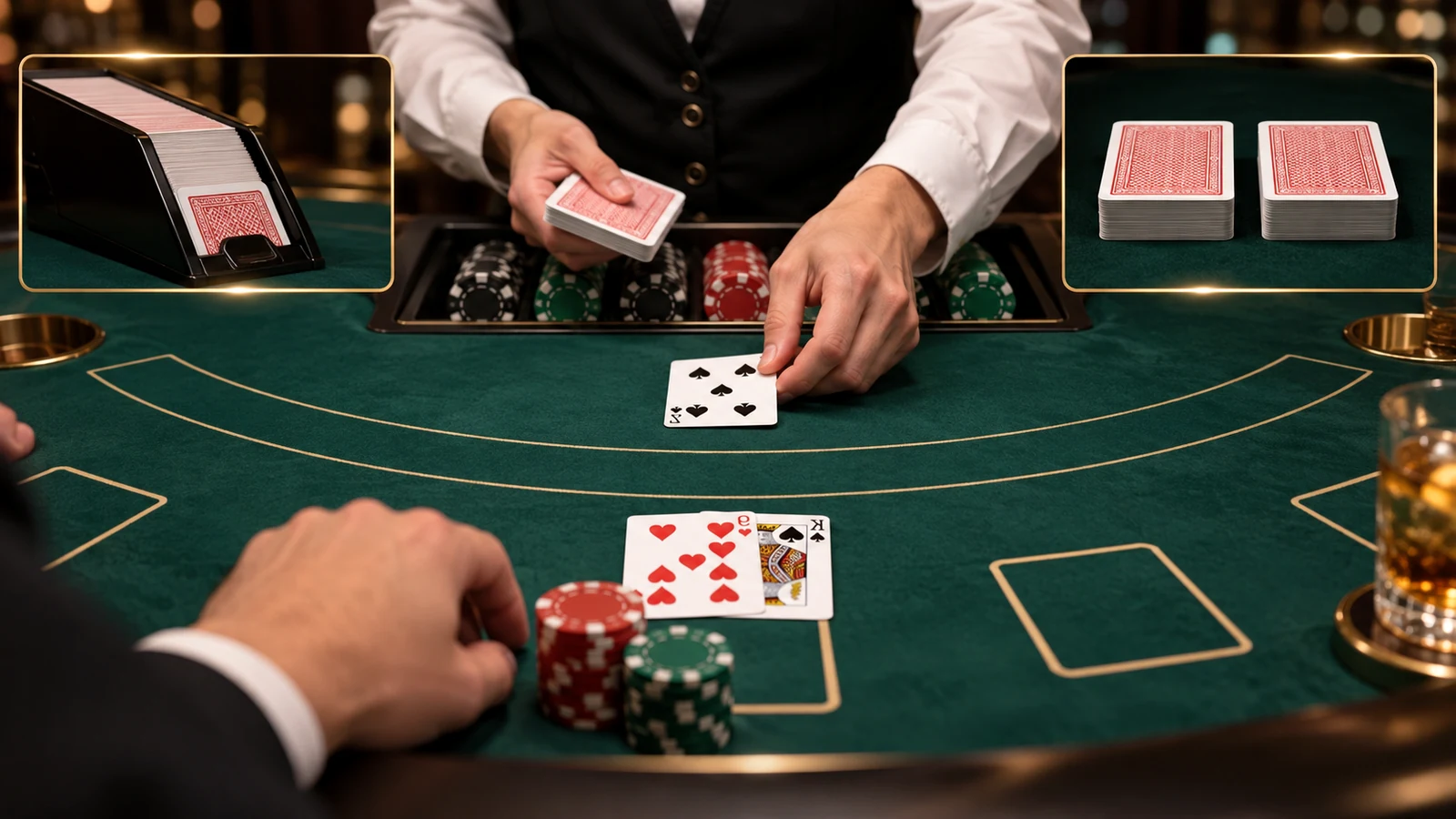
Spanish 21 Hitting and Standing Chart
The table below outlines standard hard-total decisions for Spanish 21 against each dealer up card, assuming standard Spanish 21 rules (dealer stands on soft 17, double down on any number of cards, double after split allowed, late surrender available).
| Your Hand | Dealer 2-6 | Dealer 7-9 | Dealer 10 | Dealer Ace |
|---|---|---|---|---|
| 8 or less | Hit | Hit | Hit | Hit |
| 9 | Hit | Hit | Hit | Hit |
| 10 | Double | Double | Hit | Hit |
| 11 | Double | Double | Double | Double |
| 12 | Hit | Hit | Hit | Hit |
| 13 | Stand | Hit | Hit | Hit |
| 14 | Stand | Hit | Hit | Hit |
| 15 | Stand | Hit | Surrender | Surrender |
| 16 | Stand | Stand | Surrender | Surrender |
| 17+ | Stand | Stand | Stand | Stand |
Note that several of these decisions - particularly the hit-heavy treatment of 12 and 13 against low dealer up cards, and the more frequent surrender on 15 and 16 - differ from standard blackjack strategy, precisely because of the missing 10-value cards changing the underlying probabilities.
Spanish 21 Soft Hand Strategy
| Your Hand | Dealer 2-6 | Dealer 7-9 | Dealer 10 | Dealer Ace |
|---|---|---|---|---|
| Soft 13-14 (A,2 / A,3) | Hit | Hit | Hit | Hit |
| Soft 15-16 (A,4 / A,5) | Double | Hit | Hit | Hit |
| Soft 17 (A,6) | Double | Double | Hit | Hit |
| Soft 18 (A,7) | Double/Stand | Stand | Stand | Hit |
| Soft 19+ | Stand | Stand | Stand | Stand |
Spanish 21's soft hand strategy leans more heavily on doubling than a standard blackjack chart, since the ability to double on any number of cards means a doubled soft hand that doesn't immediately win can still be improved with additional cards later - unlike standard blackjack, where a doubled hand typically receives only one additional card.
Spanish 21 Splitting Chart
| Your Pair | Dealer 2-6 | Dealer 7-9 | Dealer 10 | Dealer Ace |
|---|---|---|---|---|
| 2, 2 | Split | Hit | Hit | Hit |
| 3, 3 | Split | Hit | Hit | Hit |
| 4, 4 | Hit | Hit | Hit | Hit |
| 5, 5 | Double | Double | Hit | Hit |
| 6, 6 | Split | Hit | Hit | Hit |
| 7, 7 | Split | Split | Hit | Hit |
| 8, 8 | Split | Split | Split | Split |
| 9, 9 | Split | Split | Stand | Stand |
| 10, 10 | Stand | Stand | Stand | Stand |
| A, A | Split | Split | Split | Split |
Because Spanish 21 typically allows re-splitting and doubling after splitting, these splitting decisions are generally more favorable to split than the equivalent standard blackjack chart would suggest, since a split hand carries more upside when you can double down on the resulting hands afterward. For a deeper breakdown of splitting logic that applies across blackjack variants generally, see our blackjack splitting strategy guide.
How Spanish 21 Strategy Differs From Standard Blackjack Strategy
| Situation | Standard Blackjack | Spanish 21 |
|---|---|---|
| Hard 12 vs. dealer 4-6 | Stand | Hit (missing 10s reduces bust risk on the actual deck composition) |
| Hard 16 vs. dealer 10 | Stand (or surrender if offered) | Surrender (more often correct) |
| Doubling flexibility | Usually first two cards only | Any number of cards - used more aggressively |
| Player 21 vs. dealer 21 | Push | Player wins (built into the rules, no strategy decision needed, but shifts overall hand value calculations) |
| Surrender frequency | Limited to specific hands, if offered at all | Used more broadly due to wide availability |
For the standard blackjack baseline these differences are measured against, see our complete blackjack strategy chart.
Why the Bonus Payouts Matter for Strategy Too
Spanish 21's well-known bonus payouts - for hands like a five-card 21, a six-card 21, a 7-7-7 combination, or a suited 6-7-8 - don't change your hit/stand/double decisions directly (you're always aiming to make the best possible hand regardless of bonus potential), but they do reinforce why aggressive doubling and hitting are more often correct in this variant: a marginal hit that risks busting in standard blackjack might, in Spanish 21, carry the added incentive of building toward a bonus-paying hand, which is factored into the game's overall favorable rule structure even if it doesn't change any single strategy decision in isolation. For the full breakdown of these payouts and the rest of the game's rules, see our companion guide on Spanish 21 rules and payouts.
Common Spanish 21 Strategy Mistakes
- Using a standard blackjack chart without adjustment - the missing 10-value cards and player-favorable rules genuinely change several correct decisions, not just marginally.
- Under-using surrender - because late surrender is typically available on any hand, many players don't surrender often enough on weak totals against strong dealer up cards.
- Under-using doubling - the ability to double on any number of cards is a real strategic advantage that standard blackjack players aren't used to factoring in.
- Ignoring the missing 10s when estimating bust risk - a hard 12 or 13 is statistically slightly less likely to bust in Spanish 21 than in a standard deck, since there are fewer 10-value cards left to bust you, which shifts some hit/stand decisions.
Frequently Asked Questions
Is Spanish 21 strategy the same as regular blackjack strategy? No - while the overall framework (hit, stand, double, split based on your hand and the dealer's up card) is similar, several specific decisions differ due to the missing 10-value cards and Spanish 21's more player-favorable rule set.
Why does Spanish 21 remove the 10s? Removing all four 10-value cards from each deck increases the house edge on its own, which Spanish 21 compensates for with bonus payouts, more flexible doubling, and rules like player 21 always beating dealer 21.
Should I double down more often in Spanish 21? Generally yes, in specific situations, since Spanish 21 typically allows doubling on any number of cards rather than just the first two, making aggressive doubling more valuable than in standard blackjack.
Is surrender used more often in Spanish 21? Yes - because late surrender is commonly available on any hand in Spanish 21, correct strategy surrenders more frequently on weak totals against strong dealer up cards compared to standard blackjack, where surrender is often more restricted.
Does the missing 10s change basic hitting and standing decisions? Yes, in some cases - hands like a hard 12 or 13 face a slightly different bust probability with 10s removed from the deck, which shifts some hit/stand thresholds compared to a standard blackjack chart.
This guide is for informational purposes. Always gamble responsibly and within your means.