
Soft Hands and Soft Totals in Blackjack: Complete Strategy Guide
Soft hands are where a surprising number of blackjack players quietly give up expected value without realizing it - not because the concept is complicated, but because the correct plays often feel counterintuitive at first glance. Standing on a soft 18 against a dealer 9 feels safe; doubling down on a soft 16 against a dealer 4 feels reckless. Basic strategy says the opposite is often true. This guide explains exactly what a soft hand is, why it plays differently from a hard hand, and the complete strategy for handling every soft total correctly.

- Soft hand: Ace can count as 11 without busting
- Flexible Ace: Next card can convert Ace from 11 to 1
- Soft 18: Double, stand or hit depending on dealer card
- Multi-deck: Guide chart assumes 6-8 decks and S17
Soft hands are where a surprising number of blackjack players quietly give up expected value without realizing it - not because the concept is complicated, but because the correct plays often feel counterintuitive at first glance. Standing on a soft 18 against a dealer 9 feels safe; doubling down on a soft 16 against a dealer 4 feels reckless. Basic strategy says the opposite is often true. This guide explains exactly what a soft hand is, why it plays differently from a hard hand, and the complete strategy for handling every soft total correctly.
What Makes a Hand "Soft"?
A hand is "soft" when it contains an Ace that's currently being counted as 11 without the hand busting. Because an Ace can count as either 1 or 11, a hand like Ace-6 can be valued as either 7 (hard) or 17 (soft) - and as long as counting the Ace as 11 doesn't push the total over 21, the hand is played as "soft," giving you a built-in safety net: if you draw a card that would normally bust a hard hand, a soft hand simply converts the Ace back down to a value of 1 and continues, rather than busting.
This safety net is the entire reason soft hands are played differently from hard hands with the same numeric total. A hard 16 and a soft 17 (Ace-6) are very different propositions, even though they're separated by only one point in total value, because the soft hand can absorb a bad card without busting in a way the hard hand simply can't.
Soft vs. Hard Hands: A Direct Comparison
| Hand | Type | Why It Matters |
|---|---|---|
| 10, 6 | Hard 16 | Any card 6 or higher busts this hand |
| Ace, 5 | Soft 16 | A 10-value card just converts this to a hard 6, no bust risk |
| 9, 8 | Hard 17 | Standing is close to mandatory; hitting is risky |
| Ace, 6 | Soft 17 | Hitting carries no bust risk at all - a very different decision |
This is why a soft total should never be evaluated using the same instincts you'd apply to a hard total of the same number - the presence of the flexible Ace fundamentally changes the risk calculation.
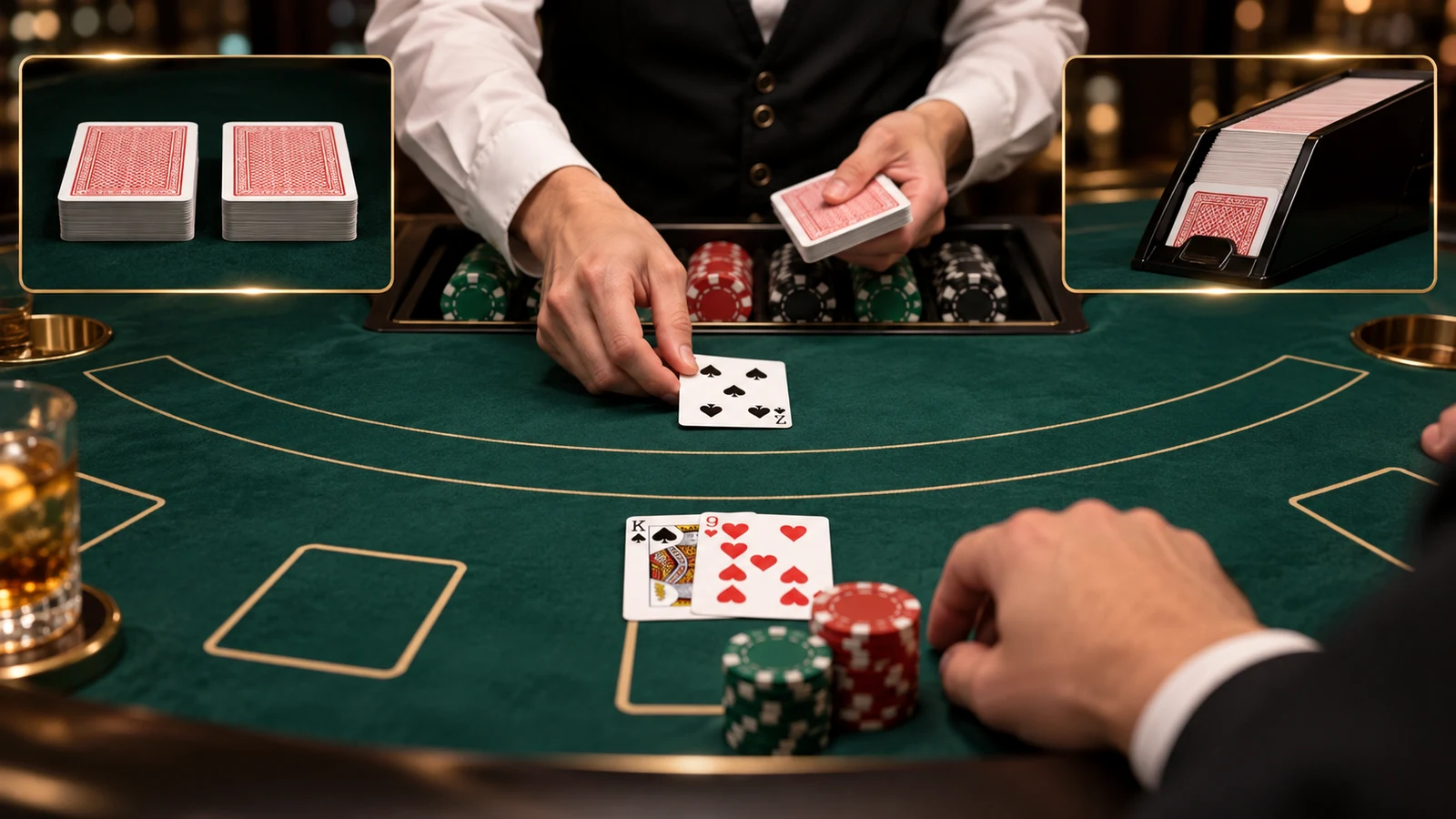
Complete Soft Hand Strategy Chart
The chart below reflects standard basic strategy for a typical multi-deck game (6-8 decks, dealer stands on soft 17). Deviations for European blackjack, Spanish 21, and other variants are covered below.
| Your Hand | Dealer 2 | Dealer 3 | Dealer 4 | Dealer 5 | Dealer 6 | Dealer 7 | Dealer 8 | Dealer 9 | Dealer 10 | Dealer Ace | |---|---|---|---|---|---|---|---|---|---|---| | Soft 13 (A,2) | Hit | Hit | Hit | Double | Double | Hit | Hit | Hit | Hit | Hit | | Soft 14 (A,3) | Hit | Hit | Hit | Double | Double | Hit | Hit | Hit | Hit | Hit | | Soft 15 (A,4) | Hit | Hit | Double | Double | Double | Hit | Hit | Hit | Hit | Hit | | Soft 16 (A,5) | Hit | Hit | Double | Double | Double | Hit | Hit | Hit | Hit | Hit | | Soft 17 (A,6) | Hit | Double | Double | Double | Double | Hit | Hit | Hit | Hit | Hit | | Soft 18 (A,7) | Double | Double | Double | Double | Double | Stand | Stand | Hit | Hit | Hit | | Soft 19 (A,8) | Stand | Stand | Stand | Stand | Double | Stand | Stand | Stand | Stand | Stand | | Soft 20 (A,9) | Stand | Stand | Stand | Stand | Stand | Stand | Stand | Stand | Stand | Stand | | Soft 21 (A,10) | Blackjack - automatic win unless dealer also has blackjack |
Why These Specific Decisions Make Sense
Soft 13-17: Hit or Double, Almost Never Stand
Notice that soft totals from 13 through 17 are never stood on in the chart above, regardless of the dealer's up card. This makes sense once you consider the safety net: because these hands can't bust on the next card (the highest possible draw, a 10-value card, brings even a soft 17 only to a hard 17 or lower), there's essentially no downside to hitting or doubling - you're only ever improving your position or, at worst, converting to a hard total that still isn't a bust. Standing on a soft 16, for example, would mean stopping at a genuinely weak total when you could have drawn again with zero bust risk.
Doubling on Soft Hands Against Weak Dealer Cards
The doubling opportunities in the middle of the chart (soft 13 through soft 18 against dealer 4, 5, or 6 specifically) reflect a combination of two favorable factors: your hand can't bust on the double-down card, and the dealer is showing a weak up card with elevated bust probability. This combination - no downside risk on your end, elevated dealer bust risk on their end - is exactly the situation basic strategy is built to capitalize on aggressively.
Soft 18: The Trickiest Total
Soft 18 (Ace-7) is the soft hand most commonly misplayed, because standing feels intuitively correct - 18 is a strong total - but the chart shows standing is only correct against dealer 7 and 8 specifically. Against a weak dealer card (2 through 6), doubling is correct, since your hand can absorb a bad card with no bust risk while the dealer is likely to bust. Against a strong dealer card (9, 10, or Ace), hitting is correct, since a bare 18 doesn't reliably beat a dealer likely to reach 19, 20, or 21, and - again - you have zero bust risk in trying to improve.
Soft 19 and 20: Stand, With One Exception
Soft 19 and soft 20 are strong enough totals to stand against nearly every dealer up card, with one specific exception: soft 19 against a dealer 6, where doubling is correct, since a dealer 6 is one of the weakest up cards in the game and your hand still carries no bust risk on the double.
Soft Hand Strategy Across Different Blackjack Variants
Double Deck Blackjack
As covered in our double deck blackjack guide, fewer decks in play shift some doubling decisions on soft hands, since the reduced deck size changes the exact probabilities enough to flip a small number of borderline calls compared to the standard multi-deck chart above.
European Blackjack
Because European blackjack doesn't use a hole card, doubling on soft hands against a dealer Ace or 10 carries the same additional risk described in our European strategy guide - you could double into a hand only to discover the dealer had blackjack all along. Several soft-hand doubling decisions against these specific up cards become more conservative as a result.
Spanish 21
Spanish 21's missing 10-value cards and permissive doubling rules (doubling on any number of cards, not just the first two) generally make soft-hand doubling more aggressive than in standard blackjack, since a doubled soft hand that doesn't immediately win can still be improved further later in the hand.
Soft Hands and Splitting
Soft totals only arise from an Ace plus a non-Ace card - meaning a pair of Aces themselves (Ace, Ace) is a distinct situation governed by splitting strategy rather than soft-hand strategy. As covered in our blackjack splitting strategy guide, a pair of Aces should be split in essentially every situation, rather than played as a single soft 12 hand, since two separate Ace-based hands carry significantly more potential than one combined hand ever could.
Soft Hands and Insurance
It's worth noting that having a strong soft hand yourself - even a soft 20 or a blackjack - has no bearing on whether you should take insurance if the dealer shows an Ace. As explained in our blackjack insurance guide, insurance odds are determined entirely by the remaining deck composition, not by the strength of your own hand, so even the strongest soft total doesn't change the (generally unfavorable) math behind taking insurance.
Common Soft Hand Mistakes
- Standing on soft 13-17 out of caution, when hitting or doubling carries zero bust risk and is almost always the better play.
- Standing on soft 18 against a weak dealer card instead of doubling, missing a favorable doubling opportunity because 18 "feels safe enough" to lock in.
- Treating soft and hard totals of the same number identically - a hard 16 and a soft 16 (Ace, 5) call for very different decisions despite sharing the same numeric value.
- Forgetting that an Ace re-values automatically - a soft hand that draws a card pushing the total over 21 as an 11 simply converts the Ace to a 1 and continues; it doesn't bust the way a hard hand would.
Frequently Asked Questions
What's the difference between a soft hand and a hard hand? A soft hand contains an Ace currently valued at 11 without busting; a hard hand either has no Ace, or has an Ace that must be valued at 1 to avoid busting. Soft hands carry a built-in safety net that hard hands don't have.
Why do you almost never stand on soft totals below 18? Because these hands can't bust on the next card - the Ace simply re-values to 1 if needed - there's essentially no downside to hitting or doubling, making standing on a weak soft total a missed opportunity rather than a safe play.
Is soft 18 a strong hand? It's moderate - strong enough to stand against a dealer 7 or 8, but better played as a double against weak dealer cards (2-6) or as a hit against strong dealer cards (9, 10, Ace), rather than automatically standing in every situation.
Does soft hand strategy change between blackjack variants? Yes - deck count, the presence or absence of a dealer hole card, and variant-specific rules like Spanish 21's missing 10s all shift specific soft-hand doubling decisions from the standard multi-deck chart.
Should I split Ace, Ace as a soft 12, or as a pair? As a pair - Ace, Ace should be split in nearly every situation rather than played as a single soft 12 hand, since two separate Ace-based hands carry significantly more value.
This guide is for informational purposes. Always gamble responsibly and within your means.