
Spanish 21 Rules & Payouts Explained
Spanish 21 is often described as one of the most player-friendly blackjack variants available - a reputation earned through a long list of bonus payouts and favorable rules that don't exist in standard blackjack. But it comes with a catch: the deck itself is different, with all the 10-value cards removed. This guide walks through exactly how Spanish 21 is played, what makes it different from standard blackjack, and the full breakdown of its bonus payout structure.
- Card deck: Each deck removes the four 10 cards
- Player wins: Player 21 beats dealer 21
- Payouts: 5-card 21, 6-7-8 and 7-7-7 can pay bonuses
- Typical: About 0.4%-0.8% with optimal strategy
Spanish 21 is often described as one of the most player-friendly blackjack variants available - a reputation earned through a long list of bonus payouts and favorable rules that don't exist in standard blackjack. But it comes with a catch: the deck itself is different, with all the 10-value cards removed. This guide walks through exactly how Spanish 21 is played, what makes it different from standard blackjack, and the full breakdown of its bonus payout structure.
What Is Spanish 21?
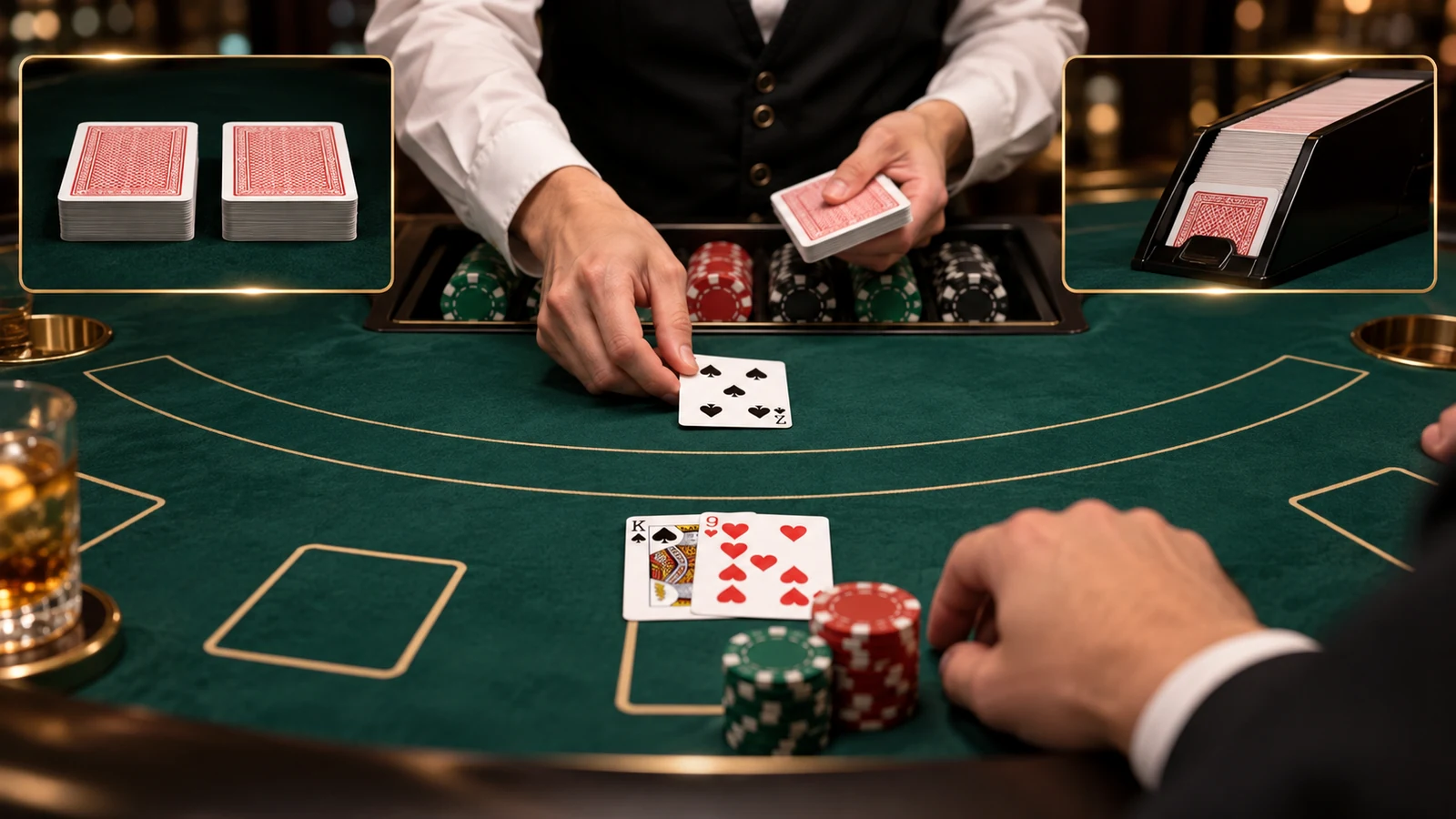
Spanish 21 is a blackjack variant played with a modified deck - a standard 52-card deck with all four 10-value cards (the actual "10" cards specifically, not the face cards) removed, leaving 48 cards per deck. Games are typically dealt from six or eight of these modified decks shuffled together. Beyond the deck itself, the core objective remains the same as standard blackjack: build a hand closer to 21 than the dealer's without going over.
What sets Spanish 21 apart isn't just the missing cards - it's the extensive list of player-favorable rules layered on top, designed specifically to offset the increased house edge that comes from removing the 10-value cards.
Why the 10s Are Removed
Removing the four 10-value cards from each deck reduces the frequency of both player and dealer blackjacks, and generally weakens the average starting hand for both sides, since 10-value cards are the single most common card value in a standard deck (10, Jack, Queen, and King all count as 10, compared to only four cards of any other individual rank). On their own, missing 10s increase the house edge meaningfully compared to a standard deck. Spanish 21's entire rule set exists specifically to counterbalance this deck disadvantage.
Spanish 21 Rules That Favor the Player
Doubling Down on Any Number of Cards
Unlike standard blackjack, where doubling down is typically restricted to your first two cards only, Spanish 21 usually allows doubling down at any point in a hand, regardless of how many cards you've already drawn. This gives players significantly more flexibility to press an advantage as a hand develops, rather than being locked into a single doubling decision at the very start.
Doubling After Splitting
Most Spanish 21 tables allow doubling down after splitting a pair, which isn't universally available in standard blackjack. This adds meaningful value to splitting decisions, since a split hand that improves can then be doubled for additional value.
Late Surrender on Any Hand
Spanish 21 typically offers late surrender - the option to forfeit half your bet and end the hand - on any two-card total, rather than restricting it to specific hands as many standard blackjack rule sets do. This gives players a meaningful escape option on weak hands against strong dealer up cards.
Player 21 Always Wins
This is one of Spanish 21's signature rules: if a player reaches a total of 21 (through any combination of cards, not just a two-card blackjack), that hand always beats the dealer, even if the dealer also has 21. In standard blackjack, a player 21 versus a dealer 21 is a push (a tie, with the original bet returned). In Spanish 21, the player wins outright in this scenario.
Bonus Payouts for Specific Hands
Spanish 21's most distinctive feature is a set of bonus payouts for specific winning hand combinations, paid regardless of what the dealer has (as long as the dealer doesn't also bust). These bonuses are the game's signature draw and are detailed in full below.
Spanish 21 Bonus Payout Table
| Hand | Typical Bonus Payout |
|---|---|
| 5-card 21 | 3 to 2 |
| 6-card 21 | 2 to 1 |
| 7-or-more-card 21 | 3 to 1 |
| 6-7-8 (mixed suits) | 3 to 2 |
| 6-7-8 (same suit) | 2 to 1 |
| 6-7-8 (spades) | 3 to 1 |
| 7-7-7 (mixed suits) | 3 to 2 |
| 7-7-7 (same suit) | 2 to 1 |
| 7-7-7 (spades) | 3 to 1 |
| 7-7-7 when dealer up card is also a 7 | Often an additional bonus, such as $1,000 or $5,000 depending on table |
Exact payout figures and available bonus combinations can vary between casinos and software providers, so it's worth checking a specific table's posted pay table before playing, since these bonuses are a major part of the game's overall value proposition and not every operator offers identical figures.
Spanish 21 House Edge
Despite the missing 10-value cards, Spanish 21's extensive player-favorable rule set brings the house edge back down to a range broadly competitive with standard blackjack - typically around 0.4% to 0.8% with optimal strategy, depending on the exact combination of rules and bonus payouts offered at a specific table.
It's worth noting that achieving this competitive house edge depends heavily on playing correct Spanish 21 strategy, which differs from standard blackjack strategy in several specific spots due to the altered deck composition and the game's unique rules. Our companion Spanish 21 strategy chart and cheat sheet covers the complete hit, stand, double, and split decisions adjusted specifically for this variant.
How Spanish 21 Differs From Standard Blackjack
| Factor | Standard Blackjack | Spanish 21 |
|---|---|---|
| Deck composition | Standard 52-card decks | 48-card decks (10s removed) |
| Doubling flexibility | Usually first two cards only | Any number of cards |
| Doubling after split | Sometimes restricted | Usually allowed |
| Surrender availability | Often limited to specific hands, if offered | Usually available on any hand |
| Player 21 vs. dealer 21 | Push | Player wins |
| Bonus payouts | None | Extensive (5-card 21, 6-7-8, 7-7-7, etc.) |
| Typical house edge | ~0.5-0.7% | ~0.4-0.8% |
Spanish 21 Splitting Rules
Spanish 21 generally allows re-splitting pairs (including re-splitting Aces, in many rule sets, which is more permissive than standard blackjack), and - as noted above - usually permits doubling down after splitting. Split Aces sometimes receive only one additional card each, similar to standard blackjack convention, though this varies by table, so it's worth checking the specific rules posted at your chosen casino.
Spanish 21 Insurance
Insurance in Spanish 21 works the same way it does in standard blackjack: when the dealer's up card is an Ace, players may place a side bet (typically up to half their original wager) that pays 2 to 1 if the dealer has blackjack. The same general guidance that applies to standard blackjack insurance applies here - it's generally not a mathematically favorable bet for players using basic strategy, regardless of the deck's altered composition. For a full breakdown of when (if ever) insurance makes sense, see our guide on blackjack insurance.
A Practical Walkthrough of a Spanish 21 Hand
- Place your ante bet.
- You and the dealer each receive two cards; the dealer shows one card face up.
- You decide to hit, stand, double down (on any number of cards, at any point in the hand, if the rules allow), or split if you have a pair.
- If your final hand totals 21 through five or more cards, or matches a specific bonus combination (like 6-7-8 or 7-7-7), the bonus payout is applied automatically in addition to your base win.
- If your total is 21 and the dealer's total is also 21, you win outright - this hand is never a push in Spanish 21, unlike standard blackjack.
- Standard win/loss/push rules apply for all other outcomes, with the dealer typically standing on soft 17, though this varies by table.
Where Spanish 21 Is Available
Spanish 21 is a licensed and trademarked game format (originally developed by Masque Publishing), which means it isn't available at every casino the way generic blackjack variants are - it requires a specific licensing arrangement between the casino or software provider and the game's rights holder. This makes it somewhat less universally available than standard blackjack, European blackjack, or other generic variants, though it remains a popular offering at many major casinos and online platforms specifically because of its strong player-facing reputation. For the complete overview of the game beyond just its rules and payouts, see our full Spanish 21 guide.
Frequently Asked Questions
Why does Spanish 21 remove the 10-value cards? Removing all four 10s from each deck is a defining feature of the game format, which increases the house edge on its own. This is deliberately offset by an extensive set of player-favorable rules and bonus payouts.
What happens if both the player and dealer have 21? In Spanish 21, the player always wins in this scenario - unlike standard blackjack, where a player 21 versus a dealer 21 is a push.
Can I double down at any point in a Spanish 21 hand? Yes, in most rule sets - Spanish 21 typically allows doubling down on any number of cards, not just the first two, which is more flexible than standard blackjack.
What is the biggest bonus payout in Spanish 21? Payouts vary by table, but a suited or spades 7-7-7 combination, especially when the dealer's up card is also a 7, can trigger some of the largest bonus payouts in the game, sometimes including a large fixed bonus on top of the standard payout ratio.
Is Spanish 21 available at every casino? No - Spanish 21 is a licensed, trademarked game format, so it's only offered by casinos and software providers with the appropriate licensing arrangement, making it somewhat less universally available than generic blackjack variants.
This guide is for informational purposes. Always gamble responsibly and within your means.