
Double Deck Blackjack: Complete Rules, Odds & Strategy Guide
How two decks change the house edge, table feel, strategy decisions and card-counting dynamics compared with single-deck and large-shoe blackjack.
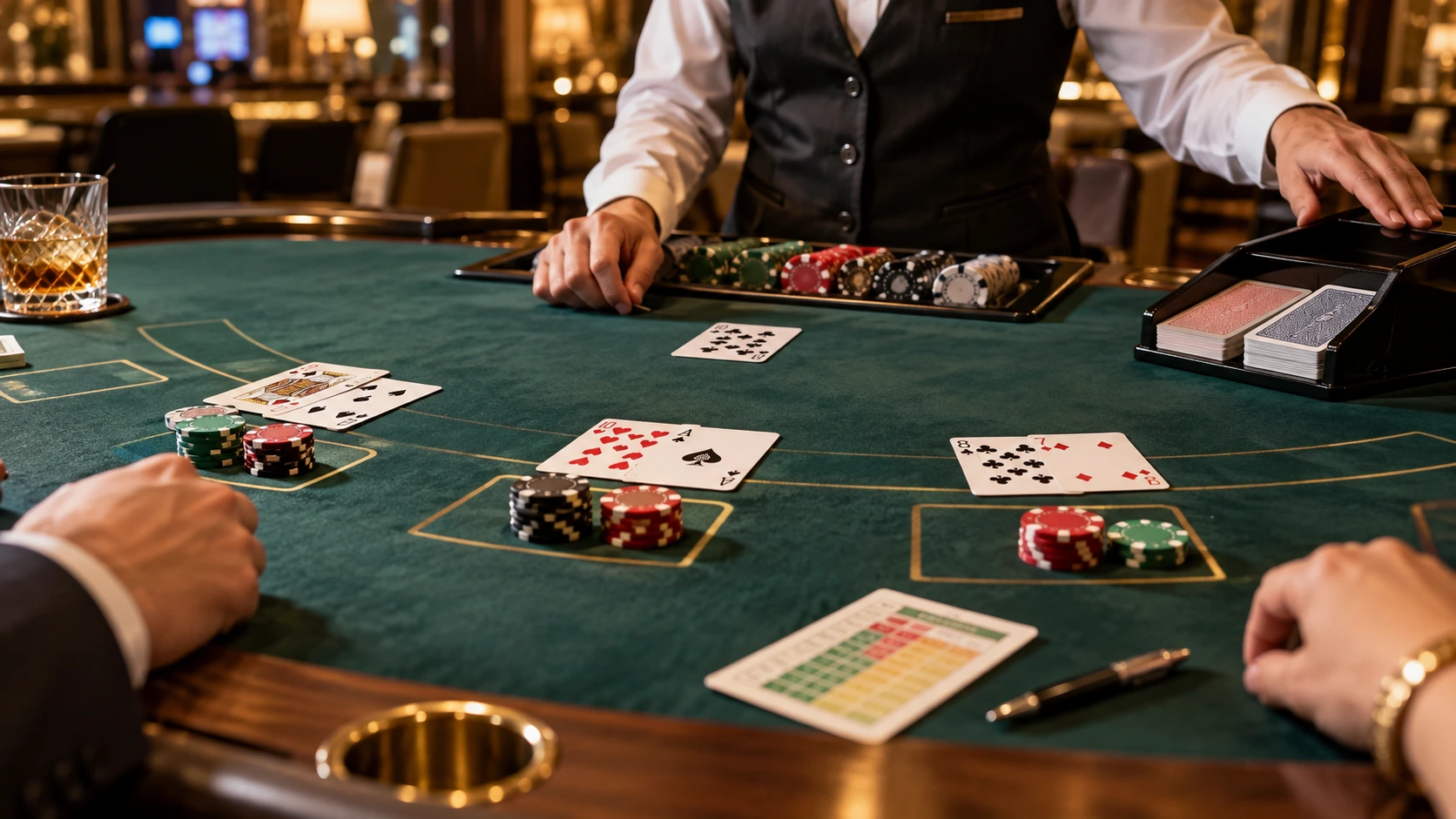
Double deck blackjack sits in a sweet spot that serious players actively seek out: fewer decks than the standard six- or eight-deck shoe games that dominate most casino floors, but still enough cards to avoid the single-deck restrictions many casinos impose (like reduced blackjack payouts). If you've ever wondered why some players specifically hunt for "2 deck" tables, or how the odds actually shift when a game moves from six decks down to two, this guide covers everything: the rules, the math, the strategy adjustments, and where to actually find it.
What Is Double Deck Blackjack?
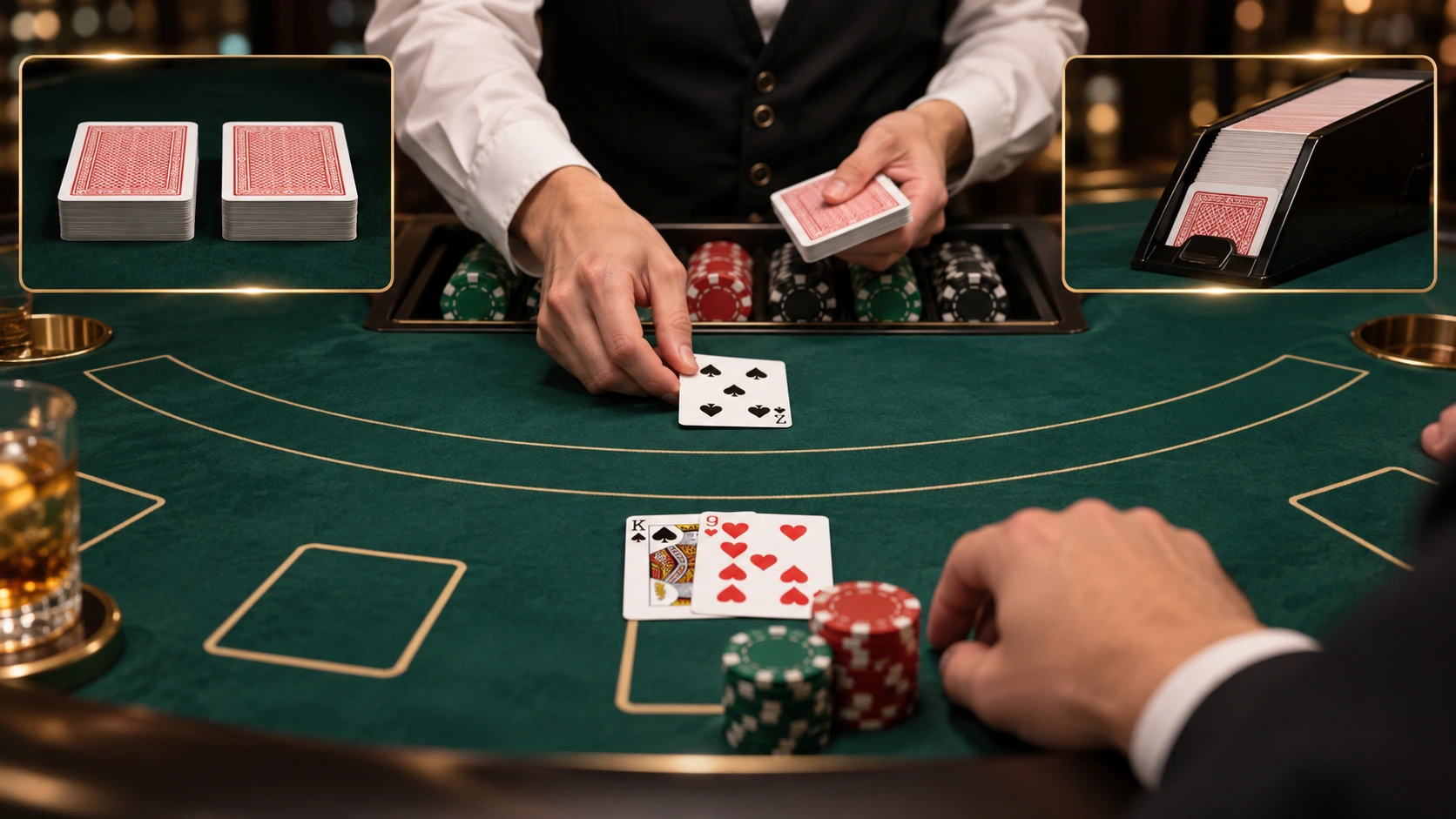
Double deck blackjack is exactly what it sounds like - a blackjack variant dealt from two standard 52-card decks (104 cards total) shuffled together, rather than the six or eight decks used in most shoe games, or the single deck used in the most player-favorable (and increasingly rare) version of the game. The core rules of blackjack - hit, stand, double down, split, dealer standing on 17 - remain unchanged. What changes is the deck composition, and that has a real, measurable effect on both the house edge and the strategy decisions that follow from it.
Double deck games are typically dealt by hand rather than from a shoe, which is part of their appeal for players who prefer a slower, more traditional pace and the ability to watch every card come out of the dealer's hand.
Why the Number of Decks Matters
Every time a card leaves the deck, it changes the composition of what's left - and with fewer decks in play, each individual card removed has a proportionally larger effect on the remaining shoe. This is the entire mathematical basis for card counting, but it also affects basic strategy and the house edge even for players who aren't counting at all.
With only two decks in play:
- Blackjacks occur slightly more often relative to a six- or eight-deck game, because removing a ten-value card or an Ace has a larger proportional impact on the remaining deck composition.
- Basic strategy deviates in specific spots compared to multi-deck strategy charts, particularly around doubling down and splitting decisions where the exact deck count changes the math meaningfully enough to flip the "correct" play.
- Card counting is far more viable, since a two-deck shoe reaches a meaningful count shift much faster than an eight-deck shoe, where the same number of cards dealt barely moves the true count.
Double Deck Blackjack House Edge
Under commonly offered rule sets, double deck blackjack carries a house edge of roughly 0.35% to 0.65% when played with optimal basic strategy - among the lowest house edges available in mainstream blackjack variants, and meaningfully better than most standard six-deck shoe games, which typically run closer to 0.5% to 0.7% depending on the specific rule combination.
The exact figure depends heavily on the table's specific rules:
| Rule Variation | Effect on House Edge |
|---|---|
| Blackjack pays 3:2 | Standard, baseline edge |
| Blackjack pays 6:5 | Adds approximately 1.4% to the house edge - a significant penalty |
| Dealer stands on soft 17 | Better for the player (lower edge) |
| Dealer hits soft 17 | Adds approximately 0.2% to the house edge |
| Double after split allowed | Better for the player (lower edge) |
| Resplitting Aces allowed | Better for the player (lower edge) |
| Surrender offered | Better for the player when used correctly |
The single most important rule to check on any double deck table is the blackjack payout. A 3:2 payout is standard and expected; a 6:5 payout - increasingly common on lower-limit tables, including some double deck games specifically marketed as a "premium" experience - erodes most or all of the mathematical advantage double deck otherwise offers over a standard shoe game. Always confirm the payout ratio printed on the felt before sitting down.
Double Deck vs. Six-Deck and Eight-Deck Games
| Factor | Double Deck | Six/Eight-Deck Shoe |
|---|---|---|
| House edge (3:2 payout, S17) | ~0.35-0.65% | ~0.5-0.7% |
| Card counting viability | High - true count shifts quickly | Lower - requires tracking many more cards |
| Dealing style | Usually hand-dealt | Usually shoe-dealt |
| Pace of play | Generally slower | Generally faster |
| Availability | Less common, often higher minimum bets | Widely available at most price points |
Double deck games are frequently positioned by casinos as a slightly premium offering - often with higher table minimums than the equivalent six-deck game - precisely because the lower house edge and higher card-counting viability make the game riskier for the house to offer at low stakes. If you're deciding between the two formats directly, our 6-deck vs. double deck comparison guide lays out the side-by-side differences in more detail.
Double Deck vs. Single Deck
It's worth noting that single deck blackjack, when available, typically offers an even lower theoretical house edge than double deck - but single deck games have become increasingly rare specifically because they're the most vulnerable to card counting, and many casinos that still offer single deck games compensate by reducing the blackjack payout to 6:5, which more than cancels out the single-deck advantage. Double deck games are far more likely to retain a standard 3:2 payout, which is why many knowledgeable players actually prefer double deck over a 6:5 single deck table, despite single deck's lower edge on paper.
Basic Strategy Adjustments for Double Deck
While the core logic of blackjack basic strategy - hit, stand, double, split, surrender based on your hand and the dealer's up card - remains the same framework across all deck counts, several specific decisions shift with only two decks in play compared to six or eight. A player using a six-deck strategy chart at a double deck table (or vice versa) will make several technically incorrect plays, even though the differences are subtle enough that many casual players never notice.
Key differences to know
- Doubling down on soft hands: Some soft-hand doubling plays that aren't correct in a six-deck game become correct in double deck, due to the higher relative frequency of favorable dealer bust cards remaining in a smaller deck composition.
- Surrender decisions: If surrender is offered, several borderline surrender hands (such as certain 15s and 16s against a dealer's strong up card) shift between "surrender" and "hit" depending on deck count.
- Splitting decisions: A handful of pair-splitting decisions, particularly involving 2s, 3s, and 6s against specific dealer up cards, differ between double deck and multi-deck strategy charts.
Because these differences are specific and situational rather than broad, the safest approach is to use a strategy chart built specifically for double deck rules rather than applying a generic six-deck chart and assuming it's close enough - in a game with an edge this thin, small deviations matter more than they would in a higher-house-edge game. For a full breakdown of splitting decisions specifically, see our guide to blackjack splitting strategy.
How to Recognize a Double Deck Table
Double deck tables are typically identified by:
- A small sign or placard on the table stating "Double Deck" or "2 Deck," often alongside the blackjack payout ratio.
- Hand-dealt cards rather than a dealing shoe - the dealer holds the two decks and deals directly from their hand rather than from a mechanical or electronic shoe.
- Slightly higher table minimums compared to the casino's standard six-deck games, reflecting the lower house edge and higher counting risk.
Online, double deck titles are typically labeled clearly in the game name or description within a casino's blackjack lobby, making them easier to identify than on a physical casino floor where the deck count isn't always obvious at a glance.
Card Counting and Double Deck Games
Double deck blackjack is a favorite among card counters specifically because a smaller deck reaches meaningful count shifts much faster than a large shoe. Systems like Hi-Lo - which assigns a value to each card as it's dealt and tracks a running count - become noticeably more powerful in a two-deck environment, since each card removed represents a larger fraction of the remaining deck.
This is precisely why double deck games are watched more closely by casino staff than equivalent six- or eight-deck games, and why some casinos limit double deck penetration (the number of cards dealt before a reshuffle) specifically to reduce the advantage a skilled counter could gain. If you're interested in the mechanics of counting systems themselves, our guide on the Hi-Lo card counting system covers the fundamentals in detail.
Playing Double Deck Blackjack Online
Double deck blackjack is available at many online casinos, both as an RNG (virtual) title and, less commonly, as a live dealer format. Because online RNG shuffles are handled by certified random number generator software rather than a physical shuffle, the deck-penetration dynamics that matter for live card counting don't apply in the same way - each round in most RNG double deck games is dealt from a freshly randomized virtual shoe rather than a continuously depleting physical one, though this varies by specific game and provider, so it's worth checking the game rules for the exact shuffling method used.
For players specifically seeking out the lowest possible house edge online, comparing the specific rule set (blackjack payout, dealer soft 17 rules, doubling and splitting restrictions) across available double deck titles matters more than the deck count alone - a well-rated six-deck game with favorable rules can sometimes edge out a double deck game with unfavorable ones. Our blackjack odds and house edge guide breaks down how each individual rule variation affects the overall edge, which is useful for comparing specific tables side by side.
Who Should Play Double Deck Blackjack?
Double deck blackjack tends to appeal most to:
- Players who want a lower house edge than standard six- or eight-deck shoe games, without the scarcity and often-reduced payouts associated with single deck tables.
- Players interested in card counting as a serious pursuit, since double deck games offer a meaningfully better counting environment than large shoe games.
- Players who enjoy a slower, hand-dealt pace, which many find more engaging and easier to follow than the faster mechanical dealing of a shoe game.
Players who prioritize speed and volume of hands per hour, or who simply want the widest possible table availability, may find standard six-deck shoe games more practical, given double deck's relative scarcity and typically higher minimum bets.
Frequently Asked Questions
Is double deck blackjack better than six-deck blackjack? Mathematically, yes, in most cases - double deck typically offers a lower house edge (around 0.35-0.65% with standard rules) compared to six-deck games (around 0.5-0.7%), assuming both offer a 3:2 blackjack payout and comparable rules otherwise.
Why do some double deck tables have higher minimum bets? Casinos often set higher minimums on double deck tables to offset the lower house edge and higher card-counting risk associated with fewer decks in play.
Does basic strategy change for double deck blackjack? Yes, in specific situations - particularly around certain doubling, splitting, and surrender decisions - though the overall framework of basic strategy remains the same across deck counts. Using a strategy chart built specifically for double deck rules is recommended for optimal play.
Is double deck blackjack easier to count cards on? Yes. Because there are fewer cards in the shoe, each card dealt has a proportionally larger effect on the remaining deck composition, making the true count shift more quickly and making counting systems more effective than in six- or eight-deck games.
What should I check before playing a double deck table? Always confirm the blackjack payout ratio (3:2 is standard; 6:5 significantly increases the house edge) and whether the dealer stands or hits on soft 17, since these two rules have the largest individual impact on the overall house edge.
This guide is for informational purposes. Always gamble responsibly and within your means.