
Spanish 21 is a blackjack-family game played with "Spanish" decks - ordinary 52-card decks with the four 10s removed. Jacks, Queens and Kings remain and are still worth 10. That makes each deck 48 cards.
Removing the 10s helps the house because 10-value cards are important to natural blackjacks, doubles and strong totals. Spanish 21 compensates with a set of player-friendly rules and bonus payouts that can make the final house edge competitive with standard blackjack when the correct strategy is used.
What is Spanish 21?
The objective is still familiar: finish with a total closer to 21 than the dealer without going over. The unusual deck and expanded player rules are what make Spanish 21 strategically different.
2-10, J, Q, K and Ace in each suit.
All four 10s removed. Face cards remain worth 10.
The missing 10s make natural blackjacks less frequent and change the probability of many hits and doubles. In return, the common Spanish 21 rules give players more ways to improve or exit a hand.
Key Spanish 21 rules
Rules vary by casino, but a common North American rule set includes the following player-friendly features.
You can give up selected weak hands for half the wager after the dealer's blackjack check.
Split hands can retain important doubling opportunities.
Common Spanish 21 rules allow Aces to be split again when another Ace appears.
A player total of 21 beats a dealer total of 21 instead of pushing.
A two-card player blackjack has priority over a dealer blackjack.
Common versions let the player double after taking additional cards, not only on the initial two-card hand.
Some common rule sets let a player surrender after doubling, forfeiting an amount equal to the original bet.
The dealer may stand or hit on soft 17 depending on the table. This changes both strategy and house edge.
Bonus payouts for making 21
One of Spanish 21's defining features is that selected 21s can receive bonus payouts. A widely used payout structure is shown below, but the exact table rules control what actually applies.
| 21 combination | Typical bonus | Notes |
|---|---|---|
| 6-7-8 or 7-7-7, mixed suits | 3:2 | Selected three-card 21 |
| 6-7-8 or 7-7-7, same suit | 2:1 | Higher suited payout |
| 6-7-8 or 7-7-7, all spades | 3:1 | Highest common combination payout |
How Spanish 21 strategy differs from standard blackjack
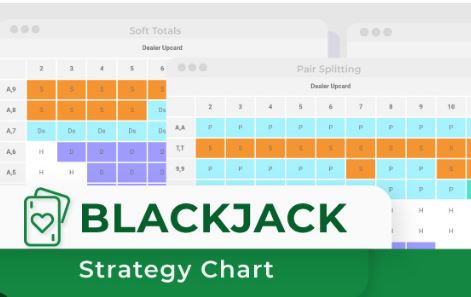
The biggest strategic mistake is assuming the standard blackjack chart still applies. It does not. The missing 10s and the extra player options change enough borderline decisions that Spanish 21 needs a dedicated strategy matched to S17/H17 and any redoubling rules.
The four numbered 10s are gone from every deck, so card composition differs from ordinary blackjack even though J, Q and K still count as 10.
Doubling on three or more cards and, in some games, redoubling creates decisions that do not exist in standard blackjack.
Late surrender and double-down rescue can turn some weak positions into controlled half-wager losses.
Because player 21 always wins, drawing to 21 has different value from a standard game where equal 21s can push.
Spanish 21 house edge
Spanish 21 can be a low-house-edge game, but the correct number depends strongly on the table rules and assumes the player uses the matching optimal strategy.
Insurance and Match the Dealer
Insurance can still be offered when the dealer shows an Ace. As in standard blackjack, it is a separate 2:1 side wager on the dealer having a 10-value hole card, and it is generally not part of optimal recreational-player strategy.
A Spanish 21 side bet based on the dealer's up card
The wager wins when one or both of your initial cards match the dealer's up card in rank. A match in both rank and suit pays more than a rank-only match.
Published common six- and eight-deck paytables produce a house edge of roughly 3%, which is much higher than the optimized main Spanish 21 game.
See why side bets have separate math →What to check before choosing a Spanish 21 table
Practical tips for Spanish 21
Do not rely on ordinary blackjack strategy for close decisions.
Surrender, flexible doubling and re-splitting only add value if you know when to use them.
Match the Dealer can be entertaining, but its house edge is far above the optimized main game.
S17/H17 and redoubling can shift the edge by several tenths of a percentage point.
Extra doubling options can increase the amount at risk quickly, so use a session budget sized for the game's volatility.
Even a 0.40% theoretical edge describes long-run expectation, not the result of a single session.
Spanish 21 vs standard blackjack
Frequently asked questions
Are all 10-value cards removed in Spanish 21?
No. Only the four cards with the printed rank 10 are removed from each deck. Jacks, Queens and Kings remain and are still worth 10.
Does a player blackjack beat a dealer blackjack?
Under the common Spanish 21 rules documented in current math references, yes - player blackjack beats dealer blackjack.
Can I use a standard blackjack strategy chart?
Not for optimal play. Spanish 21 has different deck composition and player options, so it requires its own strategy matched to the table rules.
What is the Spanish 21 house edge?
Published examples range from about 0.40% for S17 to about 0.76% for H17 without redoubling, before accounting for the Super Bonus. Exact rules matter.
Is Match the Dealer part of basic Spanish 21 strategy?
No. It is an optional side bet with a separate paytable and a significantly higher house edge than the optimized main game.
Rule and house-edge cross-check
The original 2024 article was refreshed against current Spanish 21 math references because several details - especially H17/S17, doubling and house edge - are table-rule dependent.