
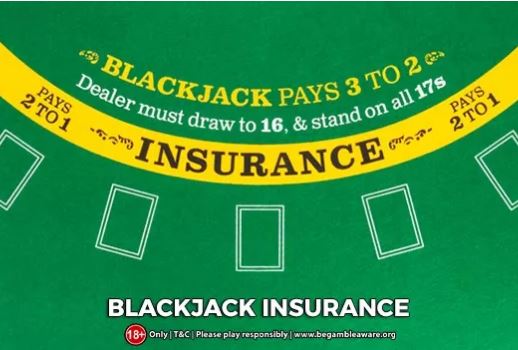
Blackjack is a game of player decisions, and insurance is one of the most misunderstood. It is offered when the dealer shows an Ace and lets you wager that the dealer's hole card is worth 10, completing a natural blackjack.
The wager can feel like a hedge against a dangerous dealer Ace. But the key question is not how safe it feels. It is whether a 2:1 payout is large enough for the actual probability that the dealer's hidden card is a 10-value card.
What is insurance in blackjack?
Insurance is offered when the dealer's face-up card is an Ace. You may normally wager up to half of your original blackjack bet that the dealer's hole card is a 10-value card - a 10, Jack, Queen or King.
The math behind insurance
Insurance is often described as a bad bet without showing the arithmetic. The important comparison is between the actual share of 10-value cards and the probability required to break even at a 2:1 payout.
In an ordinary full deck, 16 of 52 cards are worth 10: four 10s, four Jacks, four Queens and four Kings.
At a 2:1 payout, one winning insurance bet must cover two losing insurance bets.
That gap is why insurance has negative expected value for a basic-strategy player. The exact probability on a real hand changes with the cards already exposed, but the break-even requirement does not: you still need a 10-value hole card more than one-third of the time for a 2:1 wager to be profitable.
Worked example: 100 equal insurance bets
| Outcome | Approx. frequency | Result per 1-unit insurance wager | Approx. contribution |
|---|---|---|---|
| Dealer has a 10-value hole card | 30.8 times | +2 units | +61.6 units |
| Dealer does not | 69.2 times | -1 unit | -69.2 units |
| Approximate net over 100 insurance units | -7.6 units | ||
"Even money" is insurance in different clothing
If you have a natural blackjack and the dealer shows an Ace, some tables offer "even money." Instead of waiting to see whether the dealer also has blackjack, you can lock in a 1:1 payout immediately.
You give up the chance to receive the normal 3:2 blackjack payout in exchange for certainty.
Economically equivalent to insuring your blackjackIf the dealer does not have blackjack, your natural receives the normal 3:2 payout. If the dealer does have blackjack, the hand pushes.
Higher long-run expectation without count informationThat is why basic strategy treats even money and insurance the same way: decline them unless you have additional information showing that the remaining shoe is unusually rich in 10-value cards.
Pros and cons of taking insurance
When the dealer does have a natural, a correctly sized insurance payout can offset the main-hand loss.
A risk-averse player may prefer the reduced short-term swing even though the wager costs expectation over time.
The 2:1 payout requires a 33.3% success rate while the ordinary ten-value share is only about 30.8%.
Regularly adding a high-edge side bet increases the mathematical cost of the session.
The word "insurance" encourages players to think of protection rather than evaluating the side bet independently.
When insurance can actually make sense
There is a narrow exception: card counting. If enough low cards have already left the shoe, the remaining cards can become rich enough in 10-value cards for the probability of dealer blackjack to exceed the 33.3% break-even point.
Insurance can flip from negative EV to positive EV
The expanded manuscript uses roughly +3 as the rule-of-thumb threshold. This should be understood as a common Hi-Lo-style index, not a universal number for every counting system or rule set.
Without an active count that shows the remaining shoe has crossed the break-even ten density, basic strategy gives the simpler instruction: do not take insurance.
Common misconceptions about blackjack insurance
It does not alter your main hand. Insurance is a separate wager whose result depends only on whether the dealer's hole card is worth 10.
A payout cannot be judged without the probability needed to earn it. A 2:1 bet needs to win at least one-third of the time to break even.
Even money on a natural blackjack is mathematically equivalent to taking insurance on that blackjack.
The option is part of the rules. Its availability says nothing about whether the payout matches the underlying probability.
Strategic considerations
A count can identify the unusual situations where the remaining shoe is rich enough in 10-value cards to cross the break-even point.
If you take insurance for entertainment or short-term variance reasons, treat the wager separately rather than pretending it is a free safety feature.
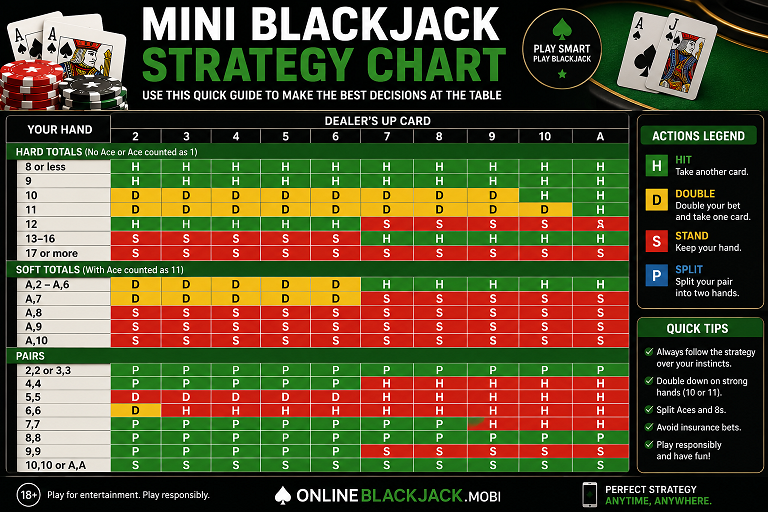
For a non-counter, the consistent strategy-chart instruction is simple: decline insurance and decline even money.
Key takeaways
It is a side bet on the dealer's hole card, not protection added to your blackjack hand.
The wager must win at least one time in three to break even.
That leaves the ordinary insurance bet with negative expected value.
Taking a guaranteed 1:1 on blackjack is equivalent to insuring the hand.
A common Hi-Lo-style index can make insurance positive EV when the shoe is sufficiently ten-rich.
Without composition information, skip Insurance and keep the lower-edge main game separate from the side wager.
Insurance sounds defensive, but mathematically it is an independent 2:1 wager that needs the dealer's hidden card to be worth 10 more than one-third of the time.